President Michelle Bachelet: A Champion for Women’s Rights in Chile
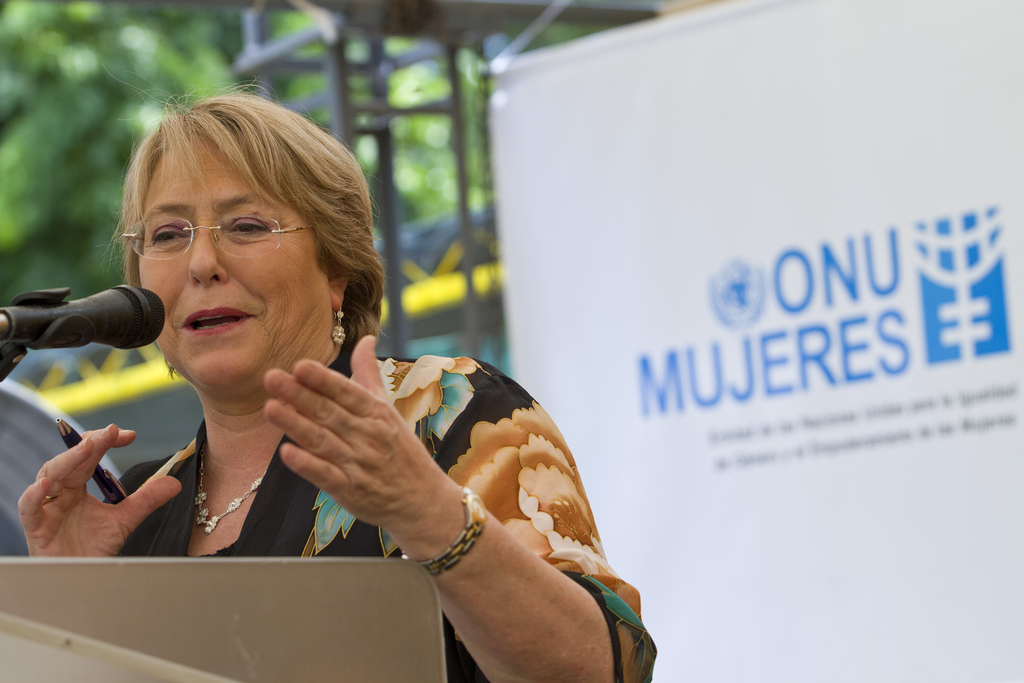
President Michelle Bachelet of Chile leaves office in March 2018. During her two terms as president, Bachelet worked tirelessly to advance women’s rights in Chile. She leaves a legacy of legislative victories in the fight for gender equality.
Bachelet entered government as an advisor in the Health Ministry. She served as Chile’s first female health minister in 2002 and its first female defense minister in 2002. She became Chile’s president in 2006. Her victory depended on the support of women — Bachelet’s victory was the first time a majority of women in Chile supported a left-of-center presidential candidate.
Time in Office
During her first term as president, Bachelet championed legislation to further women’s rights in Chile. She passed protections for victims of domestic violence, fought workplace discrimination, reformed the pension system to be fairer to women, gave low-income mothers better access to childcare and introduced universal access to emergency contraception.
Chile’s conservative governing coalition strongly opposed Bachelet’s plan to expand availability of emergency contraception. Bachelet avoided Congress by issuing executive orders to mandate that public clinics offer free emergency contraception. Her conservative congressional challengers won an appeal in the Constitutional Court, causing Bachelet to instead pursue legislative approval. The bill was popular with the public and supported through mass demonstrations against the court’s ruling. Bolstered by public approval, Bachelet fast-tracked the bill and it was approved in 2010.
Between Presidencies
Bachelet left office in 2010, unable to run for a second consecutive term due to constitutional limitations. She became the first Executive Director of the newly created U.N. Women. As the head of the organization, Bachelet worked to realize U.N. Women’s agenda — ending violence against women, economically empowering women, including women in global peace and security planning, increasing the number of women in leadership positions and influencing countries to focus national policies and budgets on increasing gender equity.
Return to Politics
Bachelet then returned to politics, winning a second term as president of Chile in 2013. In her second term, Bachelet created the Ministry of Women and Gender Equality. She also passed legislation requiring that women make up 40 percent of candidates running for an elected office.
In 2017, the Constitutional Court of Chile ruled in favor of a reproductive rights bill introduced by Bachelet. The bill legalizes abortions in extreme cases — abortions were previously illegal in all instances. Bachelet’s bill was bolstered by public support — 70 percent of Chileans approved of the legislation.
A Strong Legacy and Continued Impact
After exiting office in March 2018, Bachelet will start as Board Chair of the World Health Organization’s (WHO) Partnership for Maternal, Newborn and Child Health where she will continue to advocate for women’s rights in Chile.
“Promoting progress towards building a more equitable and just world, that guarantees the rights of women and girls, is more than a challenge,” says Bachelet. “It’s a necessity and an obligation.”
– Katherine Parks
Photo: Flickr
