4 Years After Earthquake, Haiti Tries to Rebuild
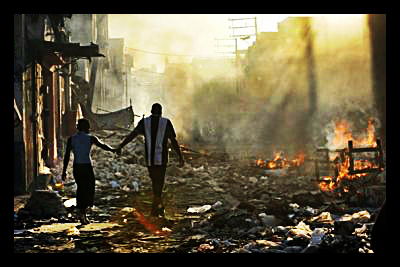
In January of 2010 Haiti was hit by a devastating earthquake that killed over 100,000 people. There was an immediate outpouring of relief for the beleaguered island nation, with supplies and relief workers pouring in to help rebuild. Four years later there is still a lot of work to be done in the nation and the aid relief that came in 2010 is not available now.
Immediately following the earthquake there were 1.5 million Haitians living in tent cities, and while that number is currently down to 146,000 people the country is hurting to relieve those displaced citizens. There is a sense that the United States and United Nations have failed the Haitian people considering the massive problems that still exist in the country and Haitians face on a daily basis.
Obviously one of the biggest issues facing post-earthquake Haiti was the shortage of safe housing with the million Haitians displaced. According to a Center for Economic and Policy Research (CEPR) study, only 7,515 houses had been built in Haiti out of a planned 15,000. This points to a lack of money gone directly through the Haitian government and being used as efficiently as it could be.
The lack of safe housing has kept many in the refugee camps that were set up for temporary use after the earthquake, but the pressure put on those administering the camps has caused the Haitian government to make some drastic decisions. In December of 2013 at least 54,000 people had been removed from camps in Canaan, a suburb of the capital of Port-Au-Prince, according to a CEPR report. That was the largest example of a series of forced evictions from these camps in 2013. The UN Refugee Agency has not extended Internally Displaced Person (IDP) protections to those in Haiti’s camps, leaving them at the whim of the government.
Part of the problem with the still-standing IDP camps is the risk for spreading disease compacted by unsanitary conditions. Cholera outbreaks have been pandemic over the last few years with thousands falling victim to the disease though it had never been reported in the nation prior to the earthquake. Over 8,000 people have died of cholera in Haiti during that that time, with 65,000 cases being reported in 2013 alone.

Since cholera had never been an issue in Haiti prior to the earthquake, there was no infrastructure to deal with the disease. While agencies and aid groups from other nations have been brought in to deal with these problems as they arise, some Haitians feel that they have just made the cholera crisis worse. In October the Institute for Justice and Democracy in Haiti (IJDH) filed a lawsuit against the United Nations claiming their practices inadvertently caused and exacerbated the epidemic. Over 5,000 Haitians were listed as plaintiffs in the suit.
There is still much work to be done in Haiti, a nation that was in dire straits even before the 2010 earthquake. There are clearly still many Haitians suffering in the aftermath of the quake, and it does not help that outside assistance has been at times hard to come by and misdirected. The situation in Haiti points to the importance of outside assistance and the need to sustain efforts well after an event like the earthquake happens. It goes to show that the events of today have far-reaching consequences and must be kept on aid agendas well after public shock has subsided.
– Eric Gustafsson
Sources: YouTube, Amnesty International, CEPR, Washington Post
Photo: The Washington Post
