Schools Advance Tsunami Readiness in the Asia-Pacific
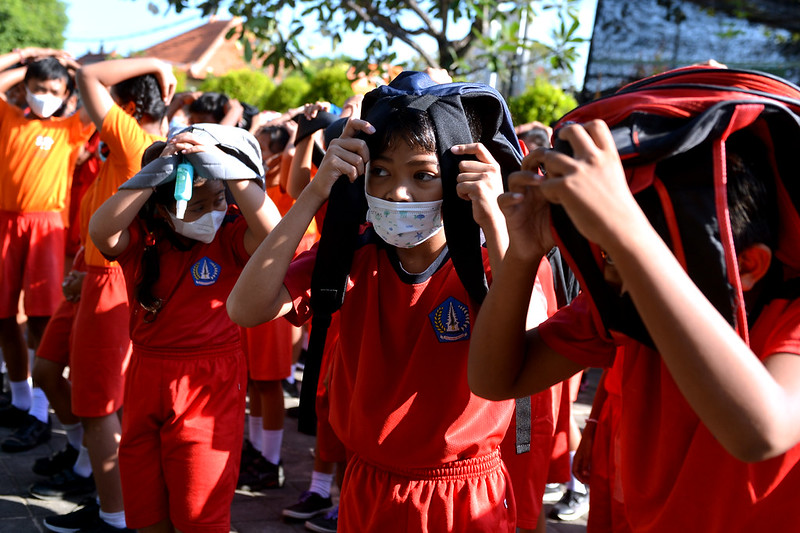 Countries in the Asia-Pacific are among the most vulnerable to tsunami hazards. The region accounts for a significant portion of the Ring of Fire, a string of coastal countries along the Pacific Ocean where nearly 80% of all tsunamis occur. Asian-Pacific nations also have a significant number of coastal communities, including some of the world’s largest megacities. This high level of coastal residence puts millions at risk, evident in the fact that the region accounts for 99% of global tsunami deaths. To reduce fatalities and enhance tsunami readiness in the Asia-Pacific, many affected countries are taking unified action. Central to this effort is increasing the resilience of school communities to these threats.
The Regional Tsunami Project
Responding to a widespread need, the United Nations Development Programme (UNDP) and the Government of Japan created a joint initiative to help countries across the Asia-Pacific enhance their tsunami preparation. The Regional Tsunami Project works with governments, schools and communities to develop locally adapted plans of action to address tsunami risk. More than 800 schools across 24 Asia-Pacific countries are involved, integrating tsunami education and evacuation drills into their curricula.
Evacuation drills give community members the knowledge and tools they need to take quick action in the face of danger. It is especially important for schools to participate in regular drills, as children remain highly vulnerable to disasters. The project’s guidebook, Regional Guide for Schools to Prepare for Tsunamis, provides actionable steps for administrators and educators to enhance planning and implement safety curricula. Widely adopted practices include educating students on how to identify tsunami hazards, using the phrase “Feel. See. Hear. Run.” as a guiding technique. During evacuation drills, students learn where their nearest safe zones are and practice moving from classrooms to these areas.
The Use of Digital Tools
Technology is changing the way communities advance tsunami readiness in the Asia-Pacific. In fact, within school administration and disaster planning, digital tools have become essential. One tool developed by the Regional Tsunami Project is STEP-A (Strengthening Tsunami and Earthquake Preparedness Assessment), an online platform used in Indonesian schools.
STEP-A helps schools determine their tsunami preparedness through self-assessment, engaging students, educators and administrators. Once preparedness levels are identified, the application provides recommended steps for improvement. School readiness information across Indonesia is then integrated into InaRISK, the national disaster-monitoring tool, which provides real-time information on community hazards.
Schools are also adopting other innovative digital tools. In Samoa, students use virtual reality headsets that simulate what their surroundings may look like during a tsunami. This technology helps younger students, many of whom have never experienced a natural disaster, visualize evacuation routes and understand flood scenarios. Research shows that immersive exercises improve knowledge retention and help students feel more confident in their ability to respond quickly during an emergency.
A Safer Future for the Asia-Pacific
The Regional Tsunami Project has laid a strong foundation for natural disaster resilience and tsunami readiness in the Asia-Pacific, especially in schools where preparation is essential to keeping younger generations safe. Digital tools will continue to play an important role, strengthening cooperation and enhancing preparedness among communities. Tsunamis will remain a serious threat in the region; however, by building the capacity to respond effectively, the Asia-Pacific can move toward a safer and more resilient future.
– Quinlan Bohannon
Quinlan is based in Portland, OR, USA and focuses on Technology and Solutions for The Borgen Project.
Photo: Flickr
