Fighting Poverty in Georgia: The Role of Black Sea
 Georgia’s policies aimed at reducing poverty have been successful, especially regarding efforts to modernize the labor market and increase access to assistance for large portions of the population. The country’s gross national income per capita rose from $3,000 in 2010 to $5,702 in 2023, along with reducing poverty in Georgia by roughly 35% in a timespan of over a decade. There is a continued sense of urgency to address and curb poverty.
Despite these efforts, in 2024, the Georgian government backtracked on European Union accession talks. This forced successful policies that reduced poverty to be abandoned, leaving only unproven strategies. The resulting suspension of some foreign aid in the form of investments will harm citizens by hindering national economic growth and slowing trade. Furthermore, some Georgians in rural regions and minority groups, consisting of Azerbaijanis and Armenians, still face high levels of poverty due to the government’s limited current legislation focused on their needs.
Ethnic tensions in Georgia are prevalent, stemming from the need to preserve the unique identity of Georgians, especially from outside invaders, including Russia. Georgia has two breakaway regions, Abkhazia and South Ossetia, both striving for independence. However, the Georgian government and people have been skeptical of foreign influence in the regions and the potential for disruption to the Georgian identity, according to the Carnegie Endowment for International Peace.
This fear, along with the hindrance of the government viewing minorities as lesser members of the nation, has restricted support and Georgia’s hope to curb poverty in predominantly minority regions.
Black Sea Importance and Access
The Black Sea is of great importance to Georgia, allowing access to beneficial trade resources and international partnerships. Partnerships between foreign nations can also enhance security, unify independent countries and provide protection in this dynamic region. Without the Black Sea, Georgia would be unable to utilize ports to facilitate trade and resource distribution.
Also, the Blue Economy or ocean resources used for economic growth, is vital to Georgia. A recent project from the European Climate, Infrastructure and Environment Executive Agency increases support for fisheries, coastal and maritime tourism and maritime transport, according to the European Commission.
Besides ports, oil and gas pipelines also flow through and around the Black Sea, creating a significant trade route from nations such as Russia and Turkey to nations in Europe. The ability for nations to tap into Western markets is key to maintaining national economic growth and potential job growth, ensuring that the nation thrives and that poverty can be reduced.
This is beneficial not only to individual nations in the region but also to the U.S., which has the goal of minimizing adversary movements in conflict zones and areas of high trade interest. Specifically, nations that can rely on Western nations for trade and an economic boost will become less dependent on Russian trade and influence. Additionally, their national independent movements will be protected, according to the Foreign Policy Research Institute.
Georgia’s Ports
Georgia’s unique location between the Black Sea and the Caspian Sea, along with neighboring Azerbaijan, allows the country to connect seven landlocked countries. It promotes trade between Europe and Asia. According to the National Library of Medicine, Georgia maintains aspirations of being a direct hub between Europe and Asia, with added economic growth, infrastructure and development. Trade agreements are vital in preserving and increasing Georgian dominance on the Black Sea to become a significant trade and support nation in a time when foreign influence downplays the nation.
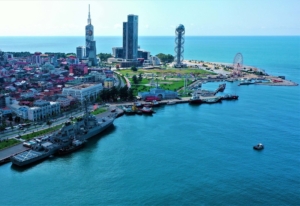
The Batumi Sea Port, located near the southwest corner of the nation, is designed to deal with cereal cargo and petroleum goods. According to the Logistics Cluster, the port transfers goods from land-based transport to ships. It also handles trade vessels and military ships from the U.S. and NATO. These military vessels dock to support regional security through joint exercises and training. By maintaining a strong flow of trade and military ships through their ports, Georgia ensures a positive economic output and strong international cooperation while maintaining security against threats.
Ongoing Strife in the Black Sea
With Russia’s ongoing expanded war against Ukraine, originating in 2014, the Black Sea is still a threatened region, facing military threats, environmental risks and disruptions to vital shipping routes. Primarily at the start of the war, the Russian Navy increased warship presence in the Black Sea and since then, both the Russian Navy and the much smaller Ukrainian Navy have utilized sea mines to deter advances from both sides.
However, with the presence of warships and mines, coastal authorities continue to warn marine traffic of the dangers, ultimately creating uncertainty in trade routes and the potential for disasters, according to the NATO Shipping Center. Environmental risks are also occurring, with mines and oil spills from Russian oil tankers harming the Black Sea shipping lanes and wildlife. Aging tankers in Russia’s shadow fleet, used to evade oil price caps, are at higher risk of spills or navigation failures. Collisions involving these vessels also disrupt trade and daily life in regions like Crimea.
With Russian deals to implement new naval policies and create new bases to house warships, Georgia will be at a disadvantage. Continued disruptions to trade and Russian influence to bar additional Georgian efforts to secure new ports and infrastructure relating to trade will negatively impact the Georgian economy and reduce poverty in Georgia.
A Future for Georgia and the Black Sea
Georgia continues to find new ways to reduce poverty. A report supported by the United Nations Development Programme (UNDP) describes how investments in social security, health care and education will help reduce poverty. To create long-lasting economic growth, the Black Sea’s role must be at the forefront of future deals. Prioritizing investment, tourism and port development will boost jobs, raise incomes and improve regional trade efficiency, key steps toward reducing poverty in Georgia.
– Avery Kachmarsky
Avery is based in Los Angeles, CA, USA and focuses on Business and Politics for The Borgen Project.
Photo: Flickr
