10 Facts About Child Soldiers in Sierra Leone
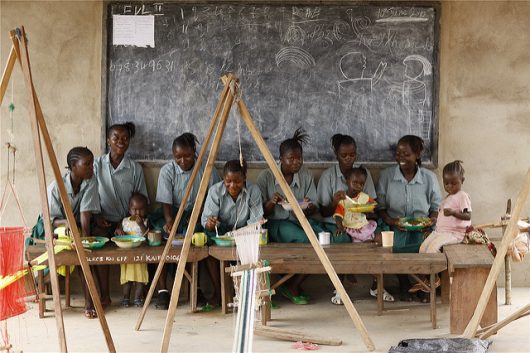
From 1991 to 2002, Sierra Leone was embroiled in a devastating civil war, fought primarily between the Revolutionary United Front (RUF) and Sierra Leone Army (SLA). This civil war garnered international attention for its blatant use of child soldiers and for the skyrocketing of child soldiers in Sierra Leone.
Child soldiers are children (defined under international law as individuals under the age of 18) who are used for any military purpose. In the Sierra Leonean civil war, children made up between 40 and 50 percent of the RUF’s military force and approximately 20 percent of the government’s military force. In total, approximately 10,000 children were exploited and forced to be child soldiers in Sierra Leone. Discussed below are the leading facts about child soldiers in Sierra Leone.
Top 10 Facts About Child Soldiers in Sierra Leone
- The term child soldier does not only include those who carry a gun and fight. Children also served as messengers and porters, and young girls were conscripted into sexual slavery or forcibly married to generals.
- Children are chosen to be soldiers because they are easily manipulated. They are more loyal and obedient than adults and they are far less likely to revolt. They also do not require wages, making them a cheap alternative to traditional soldiers.
- Children are more likely to become child soldiers if they are poor, living in a combat zone, displaced from their homes, separated from their families or have limited access to education.
- The process of reintegrating child soldiers is called Disarmament, Demobilization and Reintegration (DDR). Compounds were created to reintegrate child soldiers in Sierra Leone by providing them with education, food, shelter and psychiatric services.
- DDR is not necessarily 100 percent effective. Children may relapse into violence in adolescence and adulthood. Ishmael Beah, a former child soldier in Sierra Leone, said: “One of my greatest fears in Sierra Leone now is, if you have a large number of disgruntled and idle young people who have nothing to do with themselves, you have the possibility of sparking anything.”
- DDR camps were also not completely safe. Rebel soldiers would hang around the camps and convince previously demobilized child soldiers to rejoin the army by promising to reunite them with their families or simply threatening to kill everyone else in the camp if they did not comply.
- Children were often forced to use drugs (typically marijuana or crack cocaine) to enable them to commit violence. As a result, they had a reputation among civilians for extreme cruelty. Many boys belonged to the infamous Small Boys Unit.
- This reputation for violence was one of the key barriers to reintegration. Child soldiers had lost their childhoods and been traumatized, but many could not return home because they were seen as murderers.
- In 2013, Lt. Gen. Romeo Dallaire founded a nonprofit called the Child Soldier Initiative (CSI). It designed a mandatory training manual and seminar for police and local armed forces to inform them of children’s rights and how to handle child soldiers in the field. This training has also been used in Sudan, Mali and Cote d’Ivoire, though it is not mandatory there.
- The second phase of CSI’s project is to have former child soldiers run the program and train other children on their rights and the alternatives to joining the conflict.
Recent innovations in international human rights law, such as the Optional Protocol to the Convention on the Rights of the Child on the Involvement of Children in Armed Conflict (which has been ratified by more than 110 countries) are a reason to have hope for the future of children in conflict, as are nonprofits like the Child Soldier Initiative.
According to Theresa Betancourt, an expert in the field of child psychology in conflict and child soldiers, “We need to devise lasting systems of care, instead of leaving behind a dust cloud that disappears when the humanitarian actors leave.”
– Olivia Bradley
Photo: Flickr
