10 Facts About the Education of Refugees
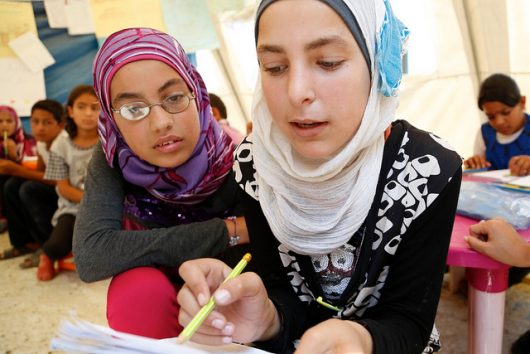
According to the Office of the U.N. High Commissioner for Refugees (UNHCR), more than half of reported refugees, 6.1 million people, are under the age of 18. Given this large youth population, the lack of education of refugees has become a significant roadblock for these children and adolescents’ future successes. Here are 10 facts about the education of refugees at present.
10 Facts About the Education of Refugees
- The UNHCR reported in 2016 that of the 6.1 million school-aged refugees, 3.7 million had no access to education. 1.75 million of these had not received a primary education, and 1.95 million had not received a secondary education.
- Comparing the education of refugees to the global average, refugees are reportedly five times less likely to attend school.
- The global average of children attending primary school is 91 percent, while the average for refugee children is 50 percent. Secondary school is even less likely for refugees, with an average of 22 percent attending, where the global average is 84 percent. Only one percent of refugees receive a college- or university-level education. This global average is 34 percent.
- The education of refugees became more difficult when the refugee population grew by 30 percent in 2014 and is predicted to continue growing. The UNHCR predicts the need for 12,000 additional classrooms and 20,000 additional teachers annually.
- Refugees are displaced from their home country for an average 20 years. Because this exceeds school-age and because the education of refugees is difficult, the potential for refugee children and adolescents to access education is minimal.
- Of the 3.7 million out-of-school refugees, more than half come from Chad, Jordan, Turkey, Ethiopia, Kenya, the Democratic Republic of the Congo and Lebanon.
- Long-term conflict tends to reverse positive trends in education. For example, 94 percent of Syrian children in 2009 received an education, but this number dropped to 60 percent in 2016.
- Progress has been made towards the education of refugees in Lebanon, Jordan, Egypt, Iraq and Turkey through an increase in encouraging school enrollment and reinforcing the “double-shift system.” This means that two groups of students receive schooling at different times with the same faculty. A lack of funding threatens this system’s future as the uneducated refugee population increases.
- The education of refugees is primarily covered by emergency funds rather than long-term programs. Given the current refugee crisis, sustainable funding is crucial for the education of refugees.
- There are a number of potential solutions to the refugee education crisis. The main three proposed solutions are accelerated education programs, online courses and expanding vocational training. Each of these is promising because they offer the flexibility that makes school attendance a realistic option.
Education has the potential to provide a safe haven for refugees and may even prevent future conflict, but the education of refugees will require systematic changes to become sustainably successful.
– Haley Hurtt
Photo: Flickr
