Solar Electric Light Fund: Fighting Time Poverty With Solar Energy
 Having sufficient time is essential for maintaining and improving all areas of life, including health, employment, education and personal well-being. However, individuals around the world face significant time deprivations, often due to unpaid labor and challenges in meeting daily survival needs. Known as time poverty, it can be understood as the lack of discretionary time that individuals experience on a daily basis.
Time poverty is especially prevalent among women and children in developing regions who perform a disproportionate amount of domestic and unpaid work. This results in a compromised ability to engage in livelihood-improving activities, such as pursuing education, securing paid employment or engaging in self-development. As a result, breaking the cycle of extreme poverty becomes increasingly challenging.
While the reality of time scarcity poses challenges for these individuals and communities, fighting time poverty is a process deeply intertwined with the fight against energy poverty.
Understanding Time and Energy Poverty
The Solar Electric Light Fund (SELF) is a nonprofit organization dedicated to combating energy poverty by providing access to solar power where it’s needed most. The Borgen Project spoke with Bob Freling, the executive director of SELF, to gain a deeper understanding of the relationship between energy and time poverty and how solar power serves as a solution to both.
Energy poverty can be defined as the lack of access to safe and adequate energy. This condition directly fuels time poverty, particularly for rural communities disconnected from central power grids. In these energy-poor regions, the absence of reliable energy to provide necessities like clean water, electricity and fuel means individuals must go through a time-consuming process to gather the raw materials needed to produce these resources.
The task of gathering these materials often falls to the women and children within a household, becoming part of their daily domestic work. For lighting and cooking, women often gather firewood or coal to create fires. Similarly, households that lack access to clean running water often require the frequent retrieval of water from distant sources.
Often, this is a process that must be repeated multiple times a day and consumes several hours a week. The United Nations (U.N.) estimates that every day, women and girls collectively spend 200 million hours on water retrieval worldwide. In these contexts, fighting time poverty becomes inseparable from addressing energy access.
Women and Children Trapped in Poverty
This widespread loss of time among women and children engenders many social disadvantages. Particularly, these demands result in reduced economic participation among women. This tradeoff between paid and unpaid labor limits women’s ability to engage in their primary occupations and compromises the opportunity for income diversification.
As a result, these women are put into positions where they are likely to remain income-poor, contributing to ongoing cycles of poverty for themselves and their families. Freling told The Borgen Project, “Time itself is a form of power – and for many women, that power has been systematically taken away. Unpaid labor is often invisible in economic systems, but its impact is enormous.”
Indeed, though largely unrecognized, unpaid labor makes significant contributions to global and national GDPs. For instance, the U.N. estimates that this work accounts for 21.4% of the average GDP in Caribbean and Latin American economies. In addition to women’s challenges, children living in time-poor households may face similar time deprivations, often resulting in long-term consequences for their education and development.
To meet basic household needs, many children must participate in domestic and income-generating tasks. These needs often take precedence over education, negatively impacting school attendance and study time and in some cases result in complete withdrawal from schooling. This has adverse effects on these children’s future ability to attain paid employment.
In addition to working in the home, time poverty may also increase children’s participation in exploitative labor within public industries, harming their health and development.
Solar Electric Light Fund: Solar-Powered Solutions
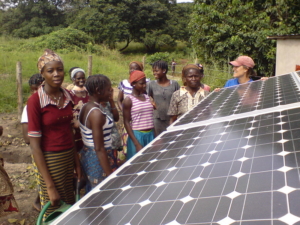
According to Freling, SELF addresses these challenges of time poverty by “tackling the underlying energy gap.” As a solution, SELF has implemented solar-powered water systems within communities, making clean water easily accessible. Many of SELF’s solar projects produce significant time-saving effects for community members, particularly in the time spent on gathering water and fuel materials.
“What was once an hour-long journey becomes a short walk down the block,” said Freling. To reduce reliance on collecting firewood, SELF provides communities with access to clean cooking alternatives through its Solar Cooking Program. This program teaches women to cook and bake using solar-powered cooking methods within their own homes, as well as for entrepreneurial purposes.
With this reclaimed time that was once allocated to collecting raw materials, women can exercise more control over their time. Often, this transition is followed by increased economic participation and productivity. This program also provides direct employment opportunities, with many participants working in or launching their own solar cooking and baking businesses.
Impacts of the Solar Electric Light Fund
Freling explains the significant impact programs like these have on fighting time poverty: “Solar energy returns time. It gives women back hours that can be spent earning income, caring for their families, learning new skills or participating in community life.” He notes, “That shift may seem simple, but over years and generations, it’s transformative.”
Alleviation from domestic and economic tasks has similar positive implications for children and their education. As households gain access to solar cooking, clean water and reliable electricity, there is a reduced need for children to contribute to household survival needs. This reclaimed time provides children with the opportunity to attend school consistently, study at home and ultimately graduate.
As noted by Freling, energy access also supports child education by freeing up time beyond daylight hours. With improved lighting systems, children can continue to read, study and learn at home after dark. SELF enables this by implementing in-home solar power systems designed to be accessible to low-income families.
These shifts improve children’s well-being and enable improved educational outcomes, making individuals and communities better equipped to work towards collective and sustainable development.
Looking Ahead
Through SELF’s dedication to affirming energy access, solar energy is fighting time poverty. It continues to dismantle the systems that perpetuate it. For women and children in developing regions, the shift to clean energy is especially transformative. As it produces significant time-saving effects for these groups, it opens doors by enabling economic participation, educational attainment and improving the quality of life.
As Freling explains, “Energy is not valuable for its own sake. It matters because of what it enables: clean water, food security, education, health care and opportunities. Over time, those gains begin to dismantle the barriers that perpetuate poverty and inequality.”
– Quinlan Bohannon
Quinlan is based in Portland, OR, USA and focuses on Technology and Solutions for The Borgen Project.
Photo: Flickr
