Small Islands and Environmental Refugees
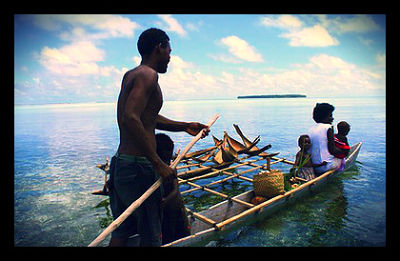
For a long time, human civilization has seen refugees from all kinds of nations, due primarily to political or militaristic reasons. However, there is set to be an occurrence of some of the first mass cases of “environmental refugees,” who will be forced to leave their homes as a result of climate change.
For example, small island nations with extensive low-lying coastal areas are placed in a difficult position because of rising seas. While for most developed countries the issue of climate change does not implicate intensive and readily apparent consequences, the same does not apply for many developing island nations—whose very existence is threatened by the projected rising seas of the near future.
The necessity for adaption is an especially prominent issue that these island nations face. This is particularly true since many of them are small and still developing, making it difficult for them to counter rising seas on their own. Moreover, public money that may be spent towards healthcare or education is often required to be reallocated towards protecting their shores. This ends up putting a drain on the economies of various island nations, making the situation for their people looks quite bleak.
The United Nations have identified 52 small island developing states that will face the brunt of climate change effects. All of them—very unique with their own lasting culture—may see their way of life come to an end, as communities will eventually become heavily displaced. However, the issue extends to a plethora of other people on a global scale as well. For instance, the majority of the global population is situated among coastal areas, while many others, over 600 million people worldwide to be exact, may also face the possibility of displacement since they are living within low-lying coastal areas less than 10 meters above sea level.
To address some of the issues presented, the United Nations General Assembly convened late in 2013. Speaking on behalf of small island developing states, the Prime Minister of Antigua and Barbuda—Winston Baldwin Spencer—spoke about the rising greenhouse gas concentrations stemming almost exclusively from a number of nations within the developed world. Pleading his case, Spencer stated that, “Developed countries should shoulder their moral, ethical and historical responsibilities for emitting the levels of anthropogenic greenhouse gases into the atmosphere. It is those actions which have now put the planet in jeopardy and compromised the well-being of present and future generations.”
Following the Kyoto Protocol, which unsuccessfully attempted to put a cap on the atmospheric carbon concentration, the United Nations has established the 2014 Climate Summit. World leaders from across the globe are expected to congregate in order to address climate issues and push for innovative solutions that span across areas including government, business, finance, industry and civil society. The Summit is planned to take place in New York during September of 2014 and will attempt to accomplish a global climate agreement. This will be of monumental significance for small island developing states as they are already doing as much as they can to limit the number of environmental refugees, but find that they still need the help and cooperation of the entire international community.
– Jugal Patel
Sources: World Issues 360, Inter-Research, United Nations, United Nations
Photo: The Age
