Providing Bicycles to Families in Africa Improves Education
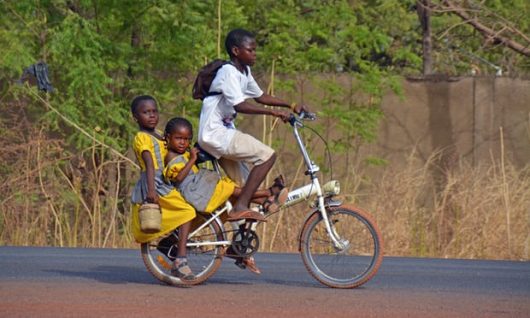 For many children living in rural villages in Africa, the most valuable educational tool is not a pencil or a notebook: it is a bicycle. Several organizations are providing bicycles to families in Africa as a means of bringing education, health services and economic stability to entire communities.
In Zambia, children often have to walk miles to get to school. They might arrive late, miss early classes and face an embarrassing punishment from the teacher. This is a particular problem for girls, who are expected to complete household chores before even starting on their journey.
In 2014, World Bicycle Relief donated 100 bikes to students and faculty at a primary school in Zambia. Now that she rides her bike to school, one girl said she can put all of her energy into concentrating in class, and she has time to study in the evenings.
Providing bicycles to families in Africa also allows them to improve their economic situations. Steel workers and chicken farmers can carry larger and heavier loads to the market. In Zambia, dairy farmers have increased their deliveries by up to 25 percent. Mine workers and door-to-door salesmen use bicycles to shorten their commutes. They save time and energy and are able to afford necessities like food and school supplies.
Women in Sierra Leone and Ghana are responsible for the vast majority of the household chores. As with the men, women use the bicycles to balance heavy materials and travel long distances. For women and girls, however, owning a bike is a form of protection–against sexual assault. Put simply, no man can outrun them anymore.
Despite this, it is far more unlikely for a woman to have access to a bicycle. In places like Sierra Leone, women are discouraged from riding bikes in the belief that it causes them to lose their virginity. Boys and men commandeer the household bicycle, claiming that the women don’t have time to learn how to ride it. However, many organizations are working against this idea: for example, the Village Bicycle Project operates a month-long Learn to Ride program for women and girls in Ghana and Sierra Leone.
Presenting one woman with a bike can improve life for an entire community. In villages in Zambia where HIV is prevalent, taking care of the sick often falls to Community Healthcare Volunteers (CHVs). They care for elderly men and women, orphaned children and those suffering from AIDS. After receiving a bicycle, one female healthcare worker was able to increase the number of patients she visited per day from four to 18.
Providing bicycles to families in Africa not only empowers rural villagers, but it also has positive implications for the environment. The organization Ghana Bamboo Bikes constructs bicycles out of bamboo, an eco-friendly material that, unlike wood, will not result in damage to Ghana’s rainforests.
The bicycles are built to be light, yet stable–good for navigating the roads of rural Ghana. The organization also teaches young men and women with little education how to build the bikes, offering them a job skill that will prove valuable as the demand for bicycles in Africa continues to grow.
– Emilia Otte
