Pakistan’s Lady Health Worker Program & Poverty Reduction
 For a low-income family living on the edge of poverty in rural Pakistan, even a minor illness can become a life-altering crisis. One medical emergency can push them deeper into systemic poverty, force children out of school and trap the family in debt they may never escape. A large majority of the Pakistani rural population falls under this socioeconomic category, where they remain “clustered just above the poverty line.”
Lacking access to quality health care, education and secure land or housing, they struggle to establish themselves within the middle class and remain constantly at risk of slipping back into poverty. At the same time, rising public debt and fiscal constraints have limited government investment in infrastructure, resulting in uneven service delivery and reduced access to essential health and education services. According to the World Bank, these domestic challenges disproportionately affect women and girls.
For example, if the journey to a school is more than five kilometres, the likelihood of girls being out of school is 76% higher than for boys.
Gendered Impacts of Poverty and Weak Health Systems in Pakistan
Furthermore, in low- and middle-income countries (LMICs) like Pakistan, particularly in rural areas, the provision of appropriate antenatal care is constrained by limited health infrastructure and a shortage of skilled medical professionals. To provide vital services to children who are most difficult to reach, community health systems are crucial. Failing social structures expose the “gendered face of poverty,” where deprivation is not only economic but also social and deeply politicized.
Women are the most excluded from public services, yet they bear the greatest burden of inadequate care. Gender-disaggregated data show that although about 45% of Pakistan’s population lives below the poverty line, more than 75% of those in poverty are women and girls. This inequality is further reflected in the World Economic Forum’s Gender Gap Index, where Pakistan ranks last out of 148 countries, underscoring persistent disparities in economic opportunity, political representation, health and education.
As a result, the country forfeits significant productive potential, as women’s labor force participation remains among the lowest in South Asia at just 21% in 2019. In Pakistan, women remain disproportionately poor due to deeply entrenched patriarchal practices, discriminatory laws and restrictive social norms.
Pakistan’s Lady Health Worker Program
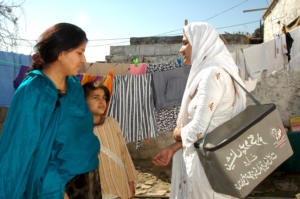
As part of its national public health strategy, Pakistan’s Lady Health Worker (LHWs) program was launched in the mid-1990s to support families with limited access to formal health care. The initiative trains local women to deliver basic health services within their communities, particularly in low-income and rural areas where clinics and hospitals are scarce. LHWs provide prenatal and postnatal care, childhood immunizations, family planning guidance and basic health education.
Because they live and work in the communities they serve, they are often the first point of contact for families with health concerns. This accessibility allows health issues to be identified and addressed early, reducing the risk of complications that would otherwise require costly emergency care. Pakistan’s maternal mortality ratio has improved significantly, falling from 432 deaths per 100,000 live births in 1985 to 155 in 2023, highlighting the importance of expanded maternal health services.
Earlier high mortality rates were largely driven by high fertility levels and limited access to health care, with only 15% of women reporting at least one antenatal care visit during their most recent pregnancy. Social and cultural constraints, such as women’s restricted mobility outside the home without an escort, further limit access to health treatment in Pakistan.
Pathways Out of Poverty
For the LHWs themselves, the position represents a significant opportunity and a pathway out of poverty. The paid role advances their education through training and practical work experience, enhancing social mobility and helping to break down class and gender barriers. After three months of classroom training, LHWs undergo a year of on-the-job training.
Although training patterns vary across provinces, this typically includes 15 days of refresher training annually, plus one week of training each month over 12 months. Because they are required to build relationships across caste and class boundaries, some LHWs have gone on to become leaders within their communities. The project also aligns with Pakistan’s broader socioeconomic transformation, including rapid urbanization, increased media exposure, growing acceptance of female education and a rising desire among women to work, particularly after gaining access to schooling.
The program is state-backed, giving participants the status of holding a “government job.” As provincial funding has increased to offset earlier federal shortfalls, the programs in Khyber Pakhtunkhwa, Punjab and Sindh are now adequately resourced, following a period of severe financial constraints across regions.
Contribution to Poverty Reduction
The LHW program contributes to poverty reduction by addressing one of the most common causes of financial instability in low-income households: preventable illness. In rural areas, many families depend on daily wages, meaning even a short illness can result in lost income. When health care is delayed or unavailable, minor health issues can quickly escalate into crises that require costly treatment or long trips to distant hospitals.
LHWs help families avoid these financial shocks by delivering preventive care at the household level. Early treatment of common illnesses, childhood immunizations and prenatal checkups all reduce the likelihood of expensive medical interventions. The program’s core objective is to provide basic preventive, promotive and curative health services within communities, particularly for women and children living in marginalized rural areas and urban slums.
Through this model, approximately 90,000 LHWs deliver primary health care to an estimated 115 million people who would otherwise have limited or no access to health services. National Vision Action Planning documents highlight the critical role of LHWs in improving the quality and accessibility of Reproductive, Maternal, Newborn, Child and Adolescent Health and Nutrition (RMNCH) services. Their work strengthens community-based care, ensures continuity of treatment in rural districts and urban slums and helps remove financial barriers that prevent families from seeking timely care.
Final Remarks
Pakistan’s Lady Health Worker program demonstrates how poverty reduction in Pakistan is closely linked to access to basic, preventive health care. By delivering essential services directly to underserved communities, the initiative helps families avoid medical expenses and income losses that often deepen poverty. Its emphasis on early intervention shows that health care can function not only as a social service but also as an economic safety net for low-income households.
Community-based health care offers a practical, affordable and sustainable response to Pakistan’s widespread poverty. Long-term funding for initiatives like these may improve public health, promote home and help end intergenerational cycles of poverty, demonstrating that significant development often starts at the community level.
– Prubleen Bhogal
Prubleen is based in London, UK and focuses on Good News and Politics for The Borgen Project.
Photo: Pixnio
