Mauritania’s Fisheries: From Ocean Wealth to Food Security
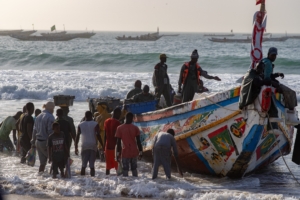 On the shores of Mauritania lies one of the world’s most abundant fishing zones, created by the convergence of two ocean currents of contrasting temperatures. This unique environment sustains an extraordinary diversity of marine life. The richness of these waters makes them a prime destination for the Mauritania locals and fishing fleets across the globe.
Mauritania’s Fisheries
The high demand of Mauritania’s fishing industry is being threatened by foreign vessels and climate instability, among other things. The fishing industry represents 10% of Mauritania’s GDP, contributes between 35% and 50% of the country’s exports and generates 29% of national budget revenue while supporting as many as 45,000 jobs directly and indirectly.
Safeguarding fishing resources for future generations requires careful monitoring of the country’s 200-mile exclusive economic zone and strict protection of designated conservation areas. Addressing these issues requires a balanced combination of policies, enforcement and community engagement.
Who Is Helping?
A German government-owned development bank, KfW, acting on behalf of the German Federal Government, has played a central role in supporting Mauritania’s efforts. It serves as a leading donor in this vital industry. Funding has been directed toward building a monitoring system integrating satellite technology with radar stations, patrol ships and surveillance vessels, strengthening the fight against illegal fishing.
Nouadhibou is one of two artisanal fishing ports undergoing significant upgrades. Improvements enhancing the oversight of local catches, raising hygiene standards and enabling safer processing all add greater value to the products.
Much of Mauritania’s catch is diverted to fishmeal and fish oil production, often because the quality is too low for direct consumption. However, the government aims to shift this trend by ensuring more of the harvest reaches people’s tables, strengthening food security domestically and across the region. To support this, KfW has introduced a line of credit for Mauritanian banks, enabling them to finance fishing businesses committed to boosting local processing and adding value within the country.
Along with KfW, Mauritania is striving to align economic growth with environmental responsibility through its Sustainable Fishery Partnership Agreement with the European Union (EU). Under this deal, the EU contributes more than $60 million yearly, allowing European fishing vessels to operate in Mauritanian waters, provided they harvest only surplus fish stocks.
Launched in 2022, the agreement features a science-driven management plan that defines catch limits, establishes protected no-fishing areas and enforces seasonal closures to support fish reproduction. Also, regulating fishmeal production and freezing methods. EU funding under the pact strengthens Mauritania’s infrastructure, enhancing ports, coast guard fleets, research facilities, nature reserves and fish markets.
Technical Measures
Over time, several technical measures have been implemented to safeguard marine populations. Starting in 1991, a seasonal pause in fishing was enforced during August and September to allow stock recovery, to which May was added in 2004.
Since 1998, restrictions on demersal fishing (fishing activities that target fish on or near the seabed) have included a cap on overall effort and a requirement that trawl nets use a minimum size. Shallow water trawling, particularly in areas below 20 meters deep, has been prohibited to protect spawning grounds and regulations now mandate minimum sizes for harvested fish.
Fishing activities are regulated through a permit system that considers vessel size, tonnage, number of fishing days, target species, operational zones and the type of gear employed. Most permits are valid for a year, though some are issued for shorter periods. Obtaining a permit requires payment of an access fee, typically determined by the vessel’s gross tonnage and the fishing method.
For pelagic species (fish typically in the midwater/upper layers of the ocean, often in large shoals), a total allowable catch (TAC) framework is in place. The scientific panels convened by the Mauritanian Institute of Oceanographic Research (IMROP) review quotas every five years.
These developments demonstrate a holistic strategy, connecting Mauritania’s fisheries policy with programs such as the Poverty Reduction and Growth Strategy. The approach promotes inclusive growth, economic diversification and social cohesion. It also enhances the coordinated management of the coastlines, ultimately strengthening the sustainability and livelihoods of those communities fishing for a living in Mauritania.
Final Remarks
Mauritania’s fisheries are vital to its economy and food security. With stronger policies, international support and sustainable practices, the country can protect its marine wealth while securing lasting livelihoods and growth.
– Gabriella Luneau
Gabriella is based in Raleigh, NC, USA and focuses on Good News and Global Health for The Borgen Project.
Photo: Wikimedia Commons
