Innovations in Agriculture Seek to Improve Tanzania’s Food Security
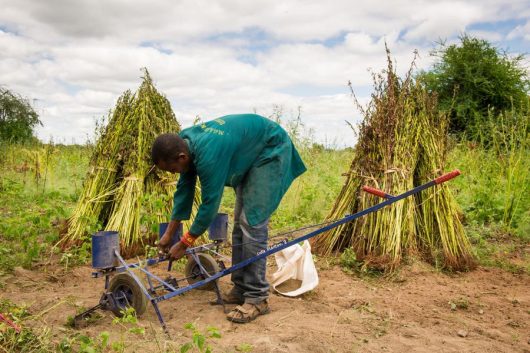
As Tanzania’s farming sector begins to shift to producing various other goods, the innovations in agriculture that enhance the productivity of the farming process are quick to follow.
Recently, the country has witnessed a transformation in its agriculture sector, especially among its smallholder farmers, after realizing the extraordinary benefits of sesame seeds.
Being both drought-resistant and considerably more resilient to climate change effects than other products, sesame has become Tanzania’s new popular food output. However, with these benefits also comes a drawback.
Though farming is essential and necessary for the well-being of the country’s citizens, the activity can sometimes be tedious and tiresome.
Sesame farming in Tanzania is labor-intensive and prolonged work, traditionally done completely by hand. Bending down, creating centimeter deep holes, dropping seeds and walking a great distance can lead to, among other things, back pain and fatigue.
That is where the phrase “necessity is the mother of invention” rang true.
In response to complaints from fellow farmers, Constantine Martin from the Babati District created an innovation in agriculture that has since been welcomed and implemented by all.
Named the “Coasta Planter,” it is simply a hand-pushed machine designed to plant sesame seeds by digging a small hole and dropping seeds in, without the need of a person constantly bending down to do so.
Additionally, the Coasta Planter is also more efficient than humans, planting the seeds at a higher rate of speed. This significant upscale in food production and potential output could lead to the strengthening of Tanzania’s food security.
Agriculture is an essential part of Tanzania’s economy, especially in terms of food production and employment generation. As of 2015, agriculture accounts for 30.5 percent of the country’s GDP and employs 75 percent of the total labor force.
To further improve and promote the importance and longevity of the agriculture sector in Tanzania, initiatives such as Feed the Future have invested in the people and the country, specifically focusing on products including rice and maize.
With this new invention in hand, farmers all across the country should expect an easier workload in the future as further clever innovations in agriculture continue to be thought of and created, enhancing Tanzania’s food security one seed at a time.
– Jordan J. Phelan
