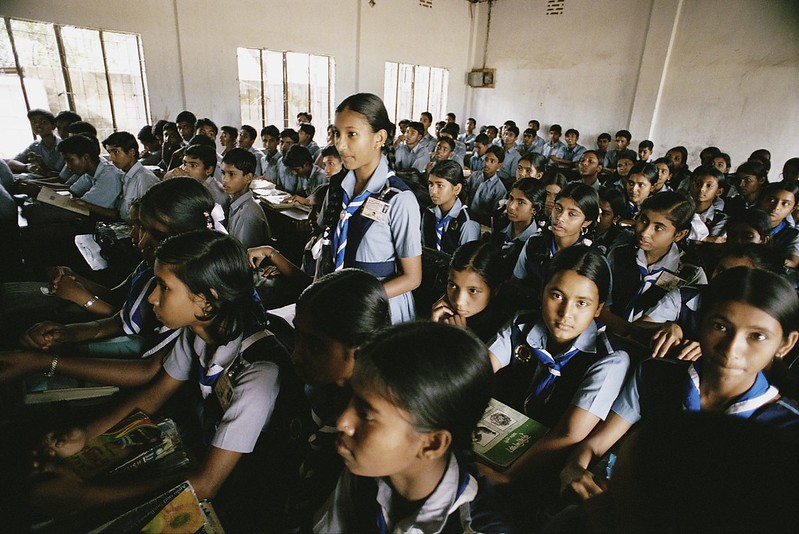
Bangladesh is a lower-middle-income South Asian country on the Bay of Bengal, between India and Burma. Its population of 168.7 million includes 27 indigenous ethnic groups that comprise 1% of its population. Once part of British India and then Pakistan, a Bengali independence movement led to war and an independent Bangladesh in 1971.
Since then, Bangladesh has been considered one of the world’s least developed countries, although it is now set to ”graduate” from that designation in November 2026.
In October 2025, the World Bank reported that between 2010 and 2022, poverty at the extreme national poverty line had dropped from 12.2% to 5.6%, but they also projected a rise in the international poverty line to 8.9%, which could affect the country’s ability to achieve middle-income status. Education clearly plays a role in the country’s development, as almost 40% of those without education experience poverty.
Status of Education
GPE (Global Partnership for Education) reports that there are about 40 million students attending school in either formal or informal settings in Bangladesh.
Although there is near-universal primary education enrollment, UNICEF reports a drop-off after that, with only 64% completing secondary education. The girls get married, the boys go to work. With 58 million children comprising 34% of the population, this can seriously impact the future workforce.
Most at risk are children with disabilities, children in disaster areas (climate: floods, cyclones, extreme heat and droughts), and the poor. GPE notes that the lowest rates are in the district of Cox’s Bazar, which houses the world’s largest refugee settlement—Rohingya refugees from Myanmar. Close to half of secondary school-aged children in Cox’s Bazar do not attend school, and government policy directives and restrictions allow only informal education of Rohingya children.
External Support for Education Improvement
UNICEF and partners are working with the Bangladesh Government to build a quality, inclusive, relevant and accessible education system. The focus is on early learning, including pre-primary, for all children, including those who are marginalized and most disadvantaged. Education and skills for adolescents will be strengthened and alternative learning pathways for the most disadvantaged out-of-school adolescents will be developed.
Current grants, from UNICEF and UNESCO, are for system capacity and program development and include a skills-focused literacy program for 6,825 out-of-school youth, preparing them for jobs in high-growth sectors.
GPE has partnered with Bangladesh since 2015 and provided almost $183 million in grant support.
Aiming to Achieve the U.N.’s SDG 2030 Agenda
In 2020, Bangladesh’s Ministry of Education and Ministry of Primary and Mass Education, with the cooperation of UNESCO, published a strategic framework for achieving the United Nations Sustainable Development Goal 4, Quality Education. The goal is to insure inclusive and equitable quality education and promote lifelong learning opportunities for all, in line with the SDG 2030 Agenda. https://planipolis.iiep.unesco.org/sites/default/files/ressources/382835eng.pdf
Curriculum reform and modernization were initiated in 2022, “fostering creativity and integrating information technology,” and began phased implementation in 2023. However, there were concerns regarding teacher preparation gaps, unclear content, and insufficient institutional capacity, leading to revised guidelines and textbooks introduced in 2025. A comprehensive revision is to be finalized in 2025 and fully implemented in 2026. https://www.dhakatribune.com/bangladesh/education/356934/ministry-new-curriculum-unfeasible-for
A February 2024 National SDG 4 Midterm Review reported that Bangladesh was ranked 101:163 on SDG 4 in the Sustainable Development Report of 2023. The report noted initiatives such as enrollment stipends, school improvements, teacher training, curriculum revision, implementation of school feeding programs and promotion of inclusive education. But challenges remain, including resource constraints, remote access, gender disparity, teacher shortages, and the “digital divide.” https://apasdg4education2030.org/wp-content/uploads/2024/06/Bangladesh-SDG4-Mid-term-Review.pdf
BRAC, the Bangladesh Rural Advancement Committee, a large international development organization, is also working with the Government of Bangladesh to achieve the SDG goals, including SDG 4. BRAC serves as the largest non-formal private education service provider in the country, reporting over 3.4 million students enrolled during 2016-2022, with 2.9 million graduating from early childhood development, pre-primary, primary and secondary programs in that same period. https://www.brac.net/SDGs/goal-4.html
A Ways to Go
Although a 2022 estimate put literacy of Bangladesh’s total population at 79% https://www.cia.gov/the-world-factbook/countries/bangladesh/#geography, the World Bank’s April 2024 learning poverty report indicated a poor learning poverty assessment for Bangladesh (based on data during COVID-19 related school closures): 51% of children at late primary age were not proficient in reading (only 8% better than the South Asian (SAR) average and 10% better than the lower-middle-income country (LMC average); 50% of students did not achieve the Minimum Proficiency Level at the end of primary school, slightly better than SAR and LMC countries.
In October 2023, The Business Standard newspaper in Bangladesh noted low quality education, reporting that just 2% of GDP is spent on education, “among the lowest globally.” In fact, they reported a drop from 14% of the country’s total budget in FY2016 to 10% in FY2024. They suggested that the emphasis on access rather than quality will impact workforce competency and the goal of achieving middle-income status by 2031. They cite low student-teacher ratio, especially in science and math, lack of proper teacher training for many teachers (exacerbated by poor salaries, low status and incentives).
https://www.tbsnews.net/features/panorama/education-bangladesh-promises-paper-only-988121
With five years until 2030, Bangladesh still has “a ways to go” to achieve the education goals of the 2030 Agenda that will enable it to secure a transition to middle-income status.
– Staff Reports
Photo: Flickr
