Screening Success and HPV Vaccination in Thailand
 Cervical cancer is a serious global public health concern. However, the World Health Organization (WHO) has launched a strategy to reduce the number of cervical cancer cases to four per 100,000 in all populations by 2030.
The Scale of the Problem in Thailand
In Thailand, human papillomavirus (HPV) has posed a significant threat. In many cases, it is harmless, but certain strands, namely 16 and 18, can lead to aggressive forms of cervical cancer. Globally, these two strands make up 70% of cervical cancer cases. Between 2001 and 2003, there were an estimated 18.1 cases per 100,000 women. This makes cervical cancer the second most common cancer in Thailand.
Public Health Minister Cholnan Srikaew acknowledged the threat these figures posed to women and introduced a national health strategy aligned with WHO’s 2030 targets: vaccinating 90% of girls by age 15, screening 70% of women aged 35–45 and ensuring timely detection of cervical lesions in 90% of affected women.
Success of the HPV Vaccination Scheme in Thailand
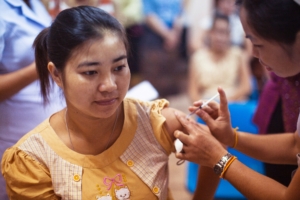
Since 2017, Thailand has offered two free doses of the HPV vaccine to all girls aged 11-12. While the country has not yet met the WHO targets, progress is clear. Before the scheme began, only 1.6% of all girls in this age group in Thailand had received the HPV vaccination; now, 83.6% have received at least one dose.
The uptake of the second dose is low. Only 59.3% have received it, but the figure is expected to rise as the national rollout scheme continues. The uptake of vaccines in the entire population is unknown, mainly due to a lack of nationwide HPV coverage data.
It is known, however, that specific communities are hesitant about the vaccine despite the rollout scheme. Studies indicate that many factors influence individuals’ decisions to receive it, including health literacy, education and socioeconomic status.
Resolving the Doubt
To tackle this hesitancy, the Thai government has launched targeted initiatives. One example is the Mother–Daughter Initiative (MDI). Mothers are encouraged to undergo cervical cancer screening, while daughters receive the HPV vaccine. Nurses and community health workers provided advocacy and education, leading to highly successful uptake rates of almost 100% in pilot districts.
Similarly, in July 2025, Thailand’s Ministry of Public Health launched a pilot initiative. It offers free single-dose HPV vaccinations to female students aged 20–26 at 24 universities, including Chulalongkorn, Mahidol and Chiang Mai. This rollout scheme resulted from surveys showing low vaccination uptake alongside limited knowledge of the disease.
Many cited cost and low perceived personal risk as reasons for lack of immunisation. These findings underscore the need for more comprehensive HPV education. However, this new program nicely complements the existing policy for girls aged 11–12, gathering data to support a potential nationwide rollout.
Expanding Cervical Cancer Screening
Screening women aged 35-60 has been a key priority alongside vaccination. It aligns with the WHO’s goal of screening 70% of women every five years through visual inspections and pap smears.
Seventy-seven percent of women have had at least one screening across Thailand. However, data indicate regular follow-up appointments are rare. Tracking is limited due to gaps in data systems. However, linking screening to ID numbers has improved follow-ups in some areas.
Overcoming Barriers
Across the country, there are clinics in every province and 186 laboratories nationwide, making screening broadly accessible. However, poverty, lack of transportation and poor road access still prevent many women from accessing these services. To improve access, the government has introduced self-administered HPV testing kits, offering greater convenience and privacy. Widespread awareness remains a challenge, however and is something that is being worked on.
While there is still work to be done, Thailand’s strategy has shown strong results. With continued effort, the country is well-positioned to meet the 2030 cervical cancer reduction goals set by the WHO.
– Niamh Trinder
Niamh is based in Leicester, UK and focuses on Global Health for The Borgen Project.
Photo: Unsplash
