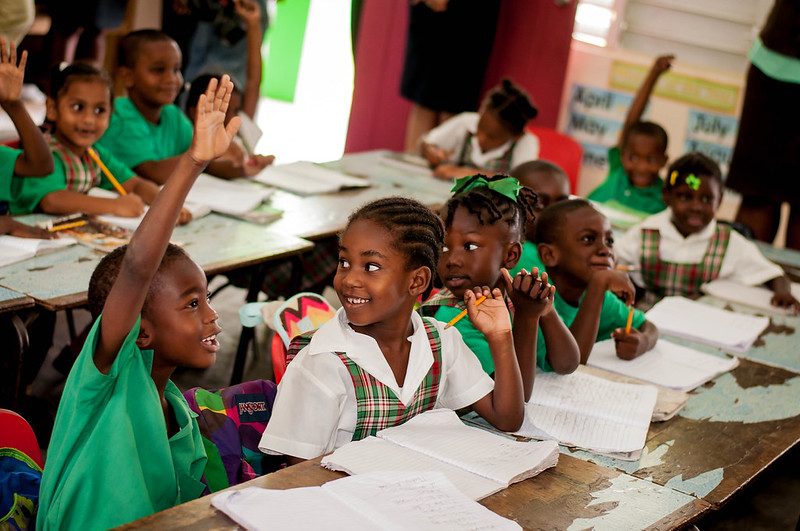
St. Kitts and Nevis stands out in the Caribbean for being the first Commonwealth nation in the region to offer free universal secondary education, introduced in 1966 after independence-era reforms that replaced the British colonial system. This novel move was rooted in a national vision that education should be a public good accessible to all citizens, helping to drive economic growth and civic participation across the twin-island federation.
The country’s Education Act outlines the right to free and compulsory education for children aged 5 to 16 and codifies the government’s responsibility to advance “quality education that develops human potential and contributes to national development”. The Ministry oversees a network of public schools on both islands, complemented by several private and faith-based institutions. While tuition-free access is nearly universal, policymakers continue to struggle with ensuring equity, teacher quality and the modernization of curricula.
Enrollment, Dropouts and System Stress
According to UNICEF, St. Kitts and Nevis has achieved almost full primary and secondary enrollment, with gross enrollment ratios above 95 % at both levels. However, the student-to-teacher ratio of 14:1 masks qualitative gaps – many teachers lack specialized training, particularly in science, mathematics and technical fields.
Teacher shortages have become a recurring challenge. A 2022 Caribbean Development Bank (CDB) review discovered that fewer than 60% of secondary-level teachers held formal certification, with turnover especially high among young teachers who migrate to larger Caribbean economies or North America. The Ministry of Education has responded through annual professional development workshops and partnerships with the University of the West Indies (UWI) and Clarendon College Jamaica, to provide remote teacher-training modules.
Infrastructure quality also varies by island and region. On Nevis, some older schools still operate without adequate laboratory equipment or digital learning facilities. The government’s Education Sector Plan 2022–2030 prioritizes classroom rehabilitation, Wi-Fi connectivity, and climate-resilient school construction.
Emerging Reforms, Interventions and Looking Ahead
The Ministry of Education continues to invest in Technical and Vocational Education and Training (TVET) to ensure student skills meet labor-market demand. The TVET Enhancement Project, supported by the Caribbean Development Bank, launched in 2019 with the goal of improving employability and entrepreneurship among youth. The initiative established national occupational standards and modernized training at the St. Kitts Technical College, which now serves as a hub for vocational and business-skills education.
Despite significant progress, St. Kitts and Nevis still doesn’t have a full-scale public university. Most students pursue tertiary studies at the University of the West Indies, the University of the Virgin Islands, or other regional institutions. The government subsidizes scholarships and student loans through its Human Resource Management Department, reflecting an understanding that higher education access is critical to sustaining economic diversification.
The national literacy rate stands at approximately 97%, one of the highest in the Caribbean. The country’s ongoing Education Sector Plan (ESP 2022-2030) seeks to strengthen teacher qualification frameworks, integrate digital learning across all schools, and bolster monitoring and evaluation systems to promote inclusive, lifelong education.
As Minister of Education Dr. Geoffrey Hanley stated in 2023, “Our small size does not limit our ambition. It empowers us to innovate faster, ensuring that every Kittitian and Nevisian child has the chance to excel.” These words epitomize the nation’s approach: building a modern education system rooted in equity and skills for a bright future.
– Jeff Zhou
Photo: Flickr
