Strengthening Children’s Education in Jordan
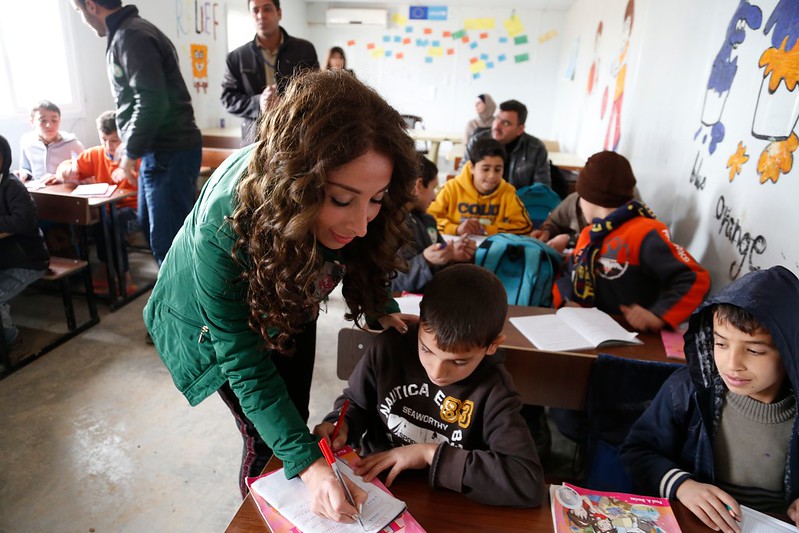 Currently, 3.8 million children live in Jordan, and only 70% are actually Jordanian. Globally, Jordan holds the second highest number of refugees per capita, typically coming from Iraq, Sudan, Somalia, Yemen, and notably, Syria. Approximately 1.3 million Syrian refugees reside in Jordan. According to UNICEF, 97% of children in Jordan attend school. While gender parity exists, the education system in Jordan is still ripe for improvement. Only 30% of second- and third-graders can fully comprehend what they are reading, which indicates subpar teaching quality. However, several initiatives are focusing on improving education in Jordan.
UNICEF Improving Education in Jordan
The strong partnership between UNICEF and the Jordanian Government has enabled 4,000 children with disabilities to enroll in public schools. In addition, UNICEF opened two more schools and provided 1,600 Ministry of Education teachers with specific training to teach students of all abilities.
Another outcome of the UNICEF and Jordanian Government’s collaboration is regarding kindergarten (KG). In Jordan, 87% of 3–4-year-olds do not attend KG 1 and 41% of 5-6-year-olds do not attend KG 2, which is concerningly low. Kindergarten education is fundamental to the rest of children’s educational careers. Without a strong foundation, continuing their education is a challenge. For this reason, the quality of preschools is being improved, and teachers are being provided better training. Besides that, UNICEF is opening classrooms in “refugee camps and community-based centres across Jordan,” increasing the number of children that can attend kindergarten, according to its website.
Drop Out and Catch Up Programs
Since November 2015, UNICEF has supported the Drop Out program, which helped 12,000 children (12 years old or younger) who have either never experienced or missed three or more years to return to school, according to its website. This propels children into their educational careers, opening more opportunities to build a future for themselves.
Similarly, since 2016, UNICEF has supported the Catch Up program, which has encouraged nearly 5,000 children, who have never attended or missed three and more years to return to school. Already, 1,700 children have officially returned and continue their educational careers, UNICEF reports.
Local Heroes
Locally, schools face the brunt of the refugee situation. In these dire times, local heroes have taken it upon themselves to lighten the situation. A prime example of this is Ms. Maha Al Ashqar, the principal of the Khawla Bint Tha’alaba Primary Girls’ School. At her school, she observed that “the Jordanian students already filled the school’s capacity.” However, this did not stop Syrian parents from reaching out and attempting to find a spot for their children.
Ms. Maha, seeing the desperation of Syrian families, struggling to find an education for their kids, agreed to allow these children in, so long as they bring a chair. She states that Syrian parents “did nothing wrong to lose the chance of educating their daughters,” believing everyone has the right to an education, regardless of their circumstances, USAID reports.
Now, the classrooms of Ms. Maha’s school are decorated with small, colorful chairs, brought in by Syrian refugee students. Each little chair represents the opportunity these children will have in the future, thanks to the education they are receiving.
– Lakshya Anand
Lakshya is based in Bellevue, WA, USA and focuses on Good News for The Borgen Project.
Photo: Flickr
