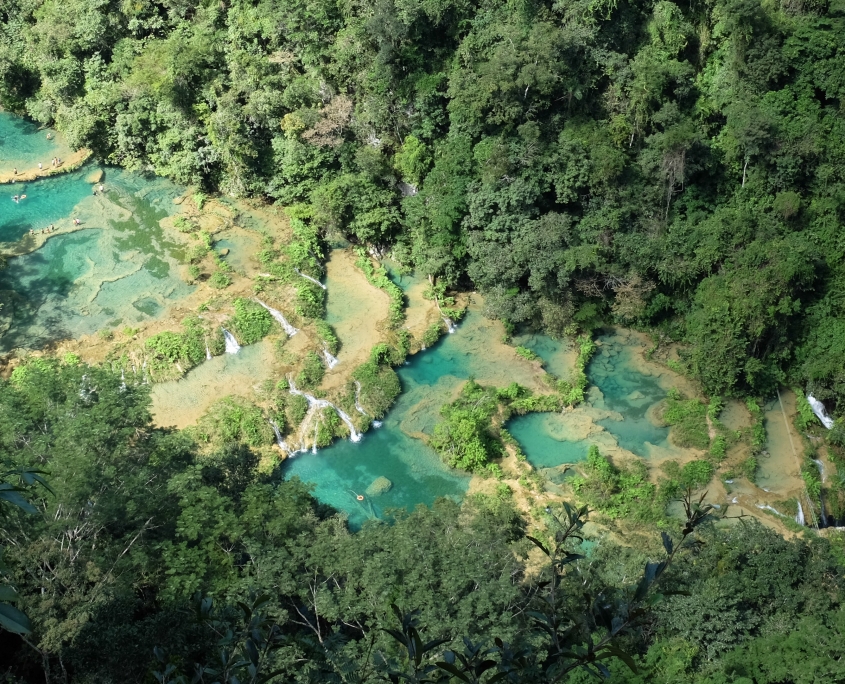
 In Guatemala’s driest corridor, farmers have lived for generations at the mercy of the region’s violent weather patterns. In the 1,600-kilometer stretch of tropical dry forest, the changing climate has transformed the traditional seasonal rhythm that brought rain into an extreme cycle of drought and flash flooding. Farmers like Maria Lopez, who depend on a small plot of maize and beans, face collapse from a single dry month, which no longer just means a poor harvest — it means total financial ruin, food insecurity for their children and the possibility of dangerous migration, a situation made more acute by recent cuts to the United States Agency for International Development (USAID). Organizations estimate that 2.7 million people across the subregion face persistent food insecurity and the changing climate threatens to worsen the ongoing crisis.
How Aid Is Helping Farmers
In the past, smallholder farmers would rely on traditional insurance to cover crop failures, which typically failed in most cases. Indemnity-based insurance requires manual adjusters to travel to remote mountain slopes to verify damage — a slow, expensive process that results in payouts arriving months after seeds have already withered. A technological shift is changing this for millions of Guatemalans. By leveraging Synthetic Aperture Radar (SAR) satellites and parametric insurance, international aid organizations such as USAID and the World Food Programme (WFP) are helping farmers build a social safety net that triggers financial aid the moment a drought begins, breaking the multigenerational cycle of poverty in Guatemala. WFP covered insurance premiums for 5,484 farming households between 2025 and 2026, providing 24,720 people with a monetary safety net to weather drought and excess rainfall.
How New Technology Is Improving the Situation
Monitoring Central American agriculture has historically been difficult for optical satellites, which take pictures like a camera and cannot see through the thick tropical cloud cover that masks the region during the critical growing season. The launch of a SAR satellite by NASA in 2025 dramatically changed this. Unlike optical sensors, SAR is an active sensor that emits its own microwave pulses, which refract from the earth’s surface. These waves penetrate through clouds, smoke and tree branches. By analyzing the backscatter — the way these waves return to the satellite — scientists can measure the moisture content in the soil.
An image of the Earth is taken twice every 12 days, with sensors resolving individual plots as narrow as 10 meters. This allows stakeholders to monitor week-to-week changes in small-scale holdings as well as broader agricultural shifts. When soil moisture levels drop below a scientifically determined threshold, the system recognizes a trigger event. Because the insurance is based on a measurable parameter rather than a physical inspection, the payout is automatic.
USAID and Poverty in Guatemala
USAID has been a central architect in scaling Insurtech solutions. Initiatives such as the Feed the Future program and partnerships with the Microinsurance Catastrophe Risk Organization have shifted the goal from reactive aid to anticipatory action. As of April 2026, the United Nations (U.N.) The Central Emergency Response Fund (CERF) released more than $10 million to preempt drought affecting Guatemala’s dry corridor. The funding does not wait for a famine to be declared. Instead, it provides cash to keep the parametric insurance pools solvent, guaranteeing that as soon as SAR data confirms a moisture deficit, farmers receive mobile payments directly to their phones.
The speed of these payments is critical for poverty alleviation in Guatemala. A farmer receiving a payout at the onset of a drought does not have to sell livestock or take out high-interest loans to buy food. The capital can be used to purchase drought-resistant seeds for a second planting or invest in small-scale irrigation.
Insights From the Field
To understand the mechanics behind SAR technology, Geospatial World interviewed Matt Wood, Vice President of Go to Market and Business at Capella Space, about the shift from traditional imaging to SAR technology.
Wood explained that, unlike traditional satellites that rely on reflected sunlight, SAR satellites emit their own energy source, which reflects off the earth and is received back by the satellite. Traditional optical satellites, he said, are limited by the same cloud cover that humans see from the ground.
On accessibility, Wood noted that SAR technology was historically the domain of defense and intelligence agencies and required very large antennas and rockets. Advances in miniaturization have changed this, allowing multiple smaller satellites to launch on a single rocket and making SAR data increasingly available for humanitarian and commercial use.
Wood cautioned that SAR data cannot be used in isolation. It needs to be combined with optical satellites, ground-based sensors, Internet of Things (IoT) sensors and other data sources to be effective. He described SAR satellites as filling a key gap in global information on a regular basis.
Looking Ahead
The combination of SAR technology and parametric insurance represents a meaningful shift in how international aid organizations support farmers in Guatemala’s dry corridor. By delivering automated, data-driven payouts at the onset of drought, these tools help smallholder farmers avoid poverty and food insecurity that have persisted for generations in Guatemala. As weather patterns continue to change across Central America, scaling these solutions will be essential to long-term poverty reduction in the region.
– Haydn Goodboy
Haydn is based in Massachusetts, USA and focuses on Good News and Technology for The Borgen Project.
Photo: Wikimedia Commons
 In the border regions of Kassala and Blue Nile in