Boko Haram’s Threat to Education in Nigeria
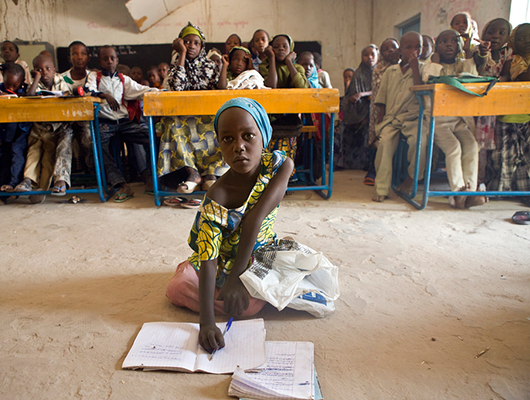
Nigeria has recently overtaken South Africa as the largest economy on its continent. In spite of its upward trajectory Nigeria still has much further to go. Boko Haram, an Islamist militant organization, has for years terrorized Nigerians by attacking officials, civilians and public institutions. Since 2009 Boko Haram has killed more than ten thousand people and displaced 1.5 million.
The organization was founded by Mohammed Yusef in 2002 in Maiduguri, in the northeastern state of Borno, to transform Nigeria into an Islamic state ruled through sharia law. Back then however, its goals did not include violent insurgency. Rather the group sought to galvanize Nigeria’s northern Muslim population against the alleged corruption in the southern government and to challenge the regional economic disparities between the Christian South and Muslim north.
When Boko Haram protested a motorbike helmet law in 2009 they became targets of armed police brutality which then sparked revolts in many of the Northern provinces. This led to military suppression of the protests, which killed 800 and led to the capture and eventual extrajudicial killing of Yusef and other sect leaders. From there, the violence began and the grouped splintered under its fragmented leadership.
Today, the elusive Abubaker Shekau leads Boko Haram’s insurgency against the Nigerian government in Borno. Shekau holds almost superhuman status; allegedly killed at least three times by the Nigerian military, videos of the enigmatic leader still continue to surface. According to The Council on Foreign Relations, “Nigerian officials and many experts are convinced that Shekau has become a brand adopted by leaders of different factions of Boko Haram, and that the men in the videos are actually look-alikes.”
Last year Shekau’s organization claimed responsibility for the kidnappings of 200 girls from a public secondary school in Chibok, Borno State, in north east Nigeria. Smaller attacks on other schools and universities preceded this tragedy and highlight one of Boko Haram’s most common targets: education. The name ‘Boko Haram’ roughly translates to ‘Western Education is Forbidden.’
Through strong arm tactics, Boko Haram has made education in northeastern Nigeria all but impossible. In the wake of the kidnappings, most secondary schools in Borno have closed. This move is particularly advantageous for Boko Haram. Closing schools leaves boys more vulnerable to its recruitment methods and perpetuates poverty. Likewise, out of school girls are more likely to be married as teens. In total, 10 million children out of a population of 160 million are not attending school. This figure represents the largest number of out of school children in the world.
However, Boko Haram is not entirely responsible for the dismal state of education. The Nigerian government has done little to improve its country’s education system. Although it is the largest economy on the continent, Nigeria spends less on education than almost every other African country. Common practice dictates that government spending on education should represent 6 percent of a country’s GDP and 20 percent of its budget. In comparison, Nigeria spends only 1.5 percent of its GDP and 6 percent of its budget on education. Despite meager spending, Nigeria’s budget could allow for three times its investment in education.
With nearly a third of the population between the ages of 10 and 24, a stronger spending in education could radically improve life in Nigeria. However, with schools closing throughout the country, the Nigeria must also focus on rooting out Boko Haram and providing better security for its students. If done in tandem, Nigeria will experience the undeniable benefits of an widespread effective education system.
– Andrew Logan
Sources: Al Jazeera 1, Al Jazeera 2, The Brookings Institute, Council on Foreign Relations, The Economist, The Guardian
Photo: Flickr
