Big Data and the Fight Against Global Poverty
Three years into the United Nations’ latest agenda to fight global poverty and promote peace, health and justice, the chief Sustainable Development Goal of 2030 to end extreme poverty has become a contest to procure and deliver the right resources for the world’s most vulnerable people at just the right pace. There is a race against rising inequality and time, but some economic circles have come to regard one performance-enhancing resource as more valuable than oil and with the potential to boost poverty relief — big data.
Big Data to End Global Poverty
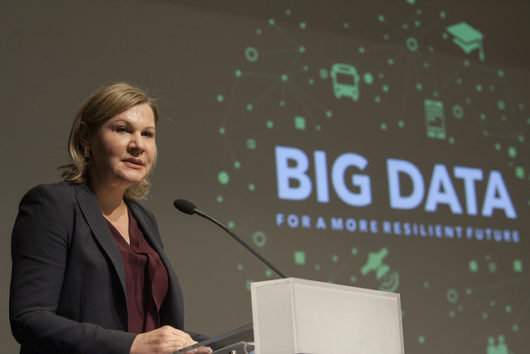
During a lecture at Singularity University Global Summit 2018, a lead economist for the World Bank, Wolfgang Fengler, shared his curiosity about using data to end global poverty by asking, “What would it take to create a data revolution for the SDGs [Sustainable Development Goals]?” Fengler oriented summit-goers to subterranean depths as he compared big data to oil, and emphasized how their values are only realized in the efficiency of its production modes: collection, refinement and delivery in a usable form.
In 1990, 1.9 billion people were considered extremely impoverished; in 2015, the final year of the United Nations Millennium Development Goals, that number was 836 million, a 66 percent decrease. Pointing to the World Poverty Clock, a real-time dashboard for poverty numbers created by Fengler, the current global poverty escape rate is 1.1 people per second. That rate should be 1.6 people per second to put an end to global poverty by 2030.
World Poverty Clock
The World Poverty Clock shows data from specific countries, and these types of snapshots provide reliable stories that can inform effective policy and strategic poverty alleviation practices. According to Singularity Hub, next steps for the World Poverty Clock include presenting data by specific regions within countries with the idea in mind that there are region-specific issues related to poverty.
Forbes Magazine contributor Bernard Marr offers some corrections to the data and oil comparison, one that suggests much richer potential for data. Oil is a finite resource that requires a massive amount of ancillary resources to deliver a final product. Contrarily, data has a low cost of production and can become more useful with every use. He also contends big data is environmentally innocuous and has a wider variety of application beyond its crude state.
New Kind of Renewable Resource
While Marr takes issue with comparing big data to an “old world resource,” he does concede to its versatility and value in shrinking hunger and battling climate change. He likens it more so to a renewable energy source such as wind or the sun. The World Poverty Clock reports that poverty is rising in 13 African nations. Two of those nations are Africa’s largest oil exporters: Angola and Nigeria, which both produced more than 1.5 million barrels of oil in 2017.
Rounding out the rest of the African OPEC nations, Guinea and Libya are labeled as “off track,” or “unable to reach the sustainable development goal target at the current rate;” Gabon and Algeria are also considered to have “no extreme poverty.” In Nigeria, oil production accounts for 10 percent of the GDP of the new world capital of extreme poverty; almost half of the nation’s 180 million people live within poverty’s grips.In Angola, 30 percent of its 25 million live in extreme poverty; oil production is expected to comprise 10 percent of its GDP.
Combatting Poverty
These macro-level findings support The Economist’s and Forbes Magazine’s positions on data’s supremacy to oil as a precious resource for profit and a poverty alleviation tool. Crude oil has less of a guarantee, if any at all, to be wielded as such a resource as it does not necessarily translate to economic stability in nations where the gross national income per capita has been decreasing since 2015.
Just as marketing research uses big data to track discrete consumer insights — such as millennial spending trends or researchers’ use of data to identify the demographic most likely to be excessive sun tanners — big data has the power for direct combat against extreme poverty.
Big Data Around the Globe
In China, the Guizhou province developed a cloud-computing platform that tracks the financial status of 6 million impoverished people in 9,000 villages. China aims to usher 10 million people out of poverty annually from 2016 to 2020. In Tongzi county, the government issued subsidies to needy villagers and a data platform monitors the distribution of these subsidies, minimizing the risk of embezzlement by unscrupulous officials.
Zhou Xing, an expert of the poverty-relief office in Guizhou province, said, “Big data really helps make poverty-relief more precise and efficient.” On the days before big data, Xing added, “poverty relief work was difficult because the information of residents was written by hand and passed to central authorities via a series of local officials, which could be hampered by corruption.”
In Rwanda, American researchers have leveraged cellphone metadata to estimate wealth and poverty distributions and the telephoning habits of the affluent and those with more modest means.
Infinite Possibilities
Putting an end to extreme poverty can potentially be achieved through fiber-optic cables rather than petroleum pipelines. The Sustainable Development Goals for 2030 are fixed; through big data, the potential for precisely architected solutions to end extreme poverty seems infinite.
– Thomas Benjamin
Photo: Flickr
