• Link to X
  • Link to Facebook
  • Link to Instagram
  • Link to TikTok
  • Link to Youtube
  • About
    • About Us
      • President
      • Board of Directors
      • Board of Advisors
      • Financials
      • Our Methodology
      • Success Tracker
      • Contact
  • Act Now
    • 30 Ways to Help
      • Email Congress
      • Call Congress
      • Volunteer
      • Courses & Certificates
      • Be a Donor
    • Internships
      • In-Office Internships
      • Remote Internships
    • Legislation
      • Politics 101
  • The Blog
  • The Podcast
  • Magazine
  • Donate
  • Click to open the search input field Click to open the search input field Search
  • Menu Menu
Blog - Latest News
Global Poverty

TOMS Builds Shoe Industry in Haiti
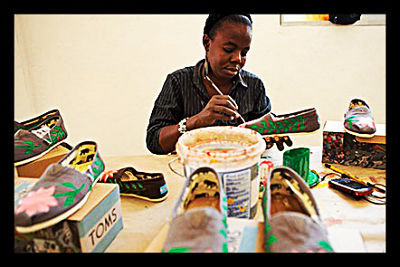
TOMS Shoes Haiti production
Founded in 2006, TOMS Shoes quickly gained mainstream popularity largely because of its socially responsible, feel-good, “one for one” model of operation. Under this model, TOMS gives away a pair of shoes to someone in a developing country for every sale of their retail shoes. However, TOMS has also come under fire over this same model that has fueled its popularity. Critics argue that donating shoes to people in developing countries can hinder economic growth by undercutting local producers.

At the 2013 Clinton Global Initiative (CGI), TOMS founder Blake Mycoskie announced his plans to begin manufacturing some of the company’s shoes in Haiti, starting early next year. This five-year investment will initially employ 50 local workers, with a goal of doubling this amount by the end of the year. This initiative comes in addition to TOMS’ existing Haiti Artist Collective program, which partners with 31 local Haitian artisans to design and hand-paint custom shoes for sale on the company’s website.

In addition to creating living wage jobs for people in Haiti, TOMS aims to provide healthcare, education and early childhood support to its factory employees by partnering with local organizations. Throughout the process, TOMS vows to oversee working conditions in Haiti and ensure that fair wages are being paid.

TOMS currently produces its shoes in China, Argentina and Ethiopia, and exports them to impoverished places. According to Public Radio International, Mycoskie has pledged that TOMS will produce at least one-third of its shoes in the countries where they are being donated to by the end of 2015. This will help build a more a sustainable, locally minded shoe industry in the countries the company serves.

After donating more than 10 million pairs of shoes to people in need, Toms is shifting its focus to targeting the causes of poverty, rather than providing temporary solutions to its complex effects.

– Tara Young

Sources: Toms Shoes, Miami Herald, Slate
Photo: HaitiLuxe Blog

October 18, 2013
Share this entry
  • Share on Facebook
  • Share on X
  • Share on WhatsApp
  • Share on Pinterest
  • Share on LinkedIn
  • Share on Tumblr
  • Share on Vk
  • Share on Reddit
  • Share by Mail
https://borgenproject.org/wp-content/uploads/borgen-project-logo.svg 0 0 Borgen Project https://borgenproject.org/wp-content/uploads/borgen-project-logo.svg Borgen Project2013-10-18 15:11:092024-06-04 01:17:32TOMS Builds Shoe Industry in Haiti

Get Smarter

  • Global Poverty 101
  • Global Poverty… The Good News
  • Global Poverty & U.S. Jobs
  • Global Poverty and National Security
  • Innovative Solutions to Poverty
  • Global Poverty & Aid FAQ’s
Search Search

Take Action

  • Call Congress
  • Email Congress
  • Donate
  • 30 Ways to Help
  • Volunteer Ops
  • Internships
  • Courses & Certificates
  • The Podcast
Borgen Project

“The Borgen Project is an incredible nonprofit organization that is addressing poverty and hunger and working towards ending them.”

-The Huffington Post

Inside The Borgen Project

  • Contact
  • About
  • Financials
  • President
  • Board of Directors
  • Board of Advisors

International Links

  • UK Email Parliament
  • UK Donate
  • Canada Email Parliament

Get Smarter

  • Global Poverty 101
  • Global Poverty… The Good News
  • Global Poverty & U.S. Jobs
  • Global Poverty and National Security
  • Innovative Solutions to Poverty
  • Global Poverty & Aid FAQ’s

Ways to Help

  • Call Congress
  • Email Congress
  • Donate
  • 30 Ways to Help
  • Volunteer Ops
  • Internships
  • Courses & Certificates
  • The Podcast
Link to: Bridging the Gap by Giving: Pedaling for Clean Water Link to: Bridging the Gap by Giving: Pedaling for Clean Water Bridging the Gap by Giving: Pedaling for Clean Water Link to: How Basket Weaving Has Helped Rwanda Recover Link to: How Basket Weaving Has Helped Rwanda Recover How Basket Weaving Has Helped Rwanda Recover
Scroll to top Scroll to top Scroll to top