The 1995 Global Summit Became a Blueprint for Ending Poverty
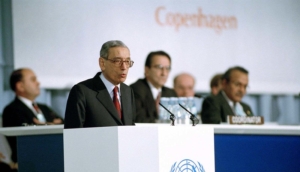 The World Summit for Social Development (WSSD) took place in 1995 in Copenhagen, Denmark. Many considered this event a catalyst for international cooperation in reducing global poverty. The 1995 Global Summit was, at its time, the largest convention of world leaders to ever meet; more than 14,000 people attended, including delegates from 186 countries, with heads of state or government representing 117 of them.
Copenhagen Declaration on Social Development
The Copenhagen Declaration on Social Development was the main political declaration that summit participants adopted in 1995. It outlines the global commitment to social development, focusing on reducing poverty.
The Copenhagen Declaration outlines ten key commitments. A summary of these commitments includes:
- Creating an environment to achieve social development.
- Eradicate poverty through national and international actions.
- Full employment, productive and freely chosen.
- Promoting social integration in society.
- Equality between men and women.
- Equitable access to quality education and health care, both physical and mental.
- Speeding up development in Africa and other developing countries.
- Strengthening civil society with structural adjustment programmes.
- Mobilizing resources allocated to social development.
- Strengthening framework for international, regional and subregional cooperation for social development.
Declaration and Program of Action
Many governments adopted a “Declaration and Program of Action” in conjunction with the Copenhagen Declaration. This meant that they agreed to put people at the center of development, to advance social development by improving 10 core areas mentioned in the Copenhagen declaration. In the declaration of action, member states made a practical implementation plan to improve and promote social development and accelerate development in Africa and other developing countries across the world.
Furthermore, this declaration aimed to achieve its goals by addressing several key issues. These included debt elimination, reorientation of agricultural policies and increased Official Development Assistance (ODA). It also addressed collective bargaining rights, poverty vulnerability indicators, traditional rights to resources and health care access for low-income families.
How Did It Become a Blueprint for Ending Poverty?
- Global unanimity on poverty being a political and moral priority. Additionally, poverty can be addressed through coordinated policies.
- It became a catalyst for national anti-poverty strategies, as the 1995 Global Summit encouraged countries to create their own poverty reduction plans.
- Acknowledgement of the importance of a civil society. This event gave a platform to charities, NGOs and marginalized communities.
- Transition toward people-centered development, rather than economic development being a priority. The 1995 Global Summit made clear the importance of poverty being a multidimensional issue, comprising access to health care, education and social participation.
30-Year Anniversary of the WSSD
In 2025, 30 years after the 1995 Global Summit, the United Nations (U.N.) will meet for the second WSSD, this time in Doha, Qatar, in November 2025. This summit will give global leaders the opportunity to rethink their position on social development and realign poverty as a political priority. The 2025 summit will also create an opening to discuss crucial issues that weren’t a priority 30 years ago, while also rebuilding trust between institutions and multilateralism.
– Emma Dornan
Emma is based in Fife, Scotland and focuses on Technology and Politics for The Borgen Project.
Photo: Flickr
