8 Facts About Education in Sierra Leone
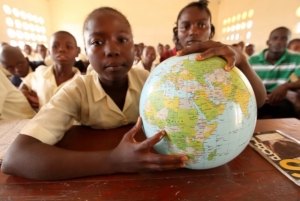
Situated towards the bottom of the bulge on Africa’s west coast, Sierra Leone sits on top of one of the most concentrated gold and diamond deposits in the world. But the country’s history as a prime subject of colonialism’s horrors explains why it consistently ranks as one of the poorest in the world. Here are eight facts about education in Sierra Leone that help gage context for the country’s current state of affairs.
8 Facts About Education in Sierra Leone
- Poor Education Statistics- As is typical in low-income communities, the country, now with a population of more than 7.5 million people, yields unimpressive statistics when it comes to categories such as enrollment, completion and literacy. A 2016 UNESCO report found that only 47 percent of all primary school students progressed to their last year, which is the American equivalent of fifth-grade. However this social problem is well recognized, and the country’s most recent president-elect, Julius Maada Bio, even incorporated it as one of the pillars of his campaign.
- Recent Switch in the System- In 2017, Sierra Leone switched its education structure from a 3-6-3-4 system. The current Sierra Leonean educational system now operates under what is known as a 6-3-3-4 structure. This means that a student’s “complete” schooling is broken into four parts: six years of pre-primary school, three years of junior secondary school, three years of senior secondary school and four years at a college program.
- Testing into Higher Education- Students face obstacles along the way through their education, as after the first nine years, which are compulsory education, they must take a Basic Education Certificate Examination which determines who can proceed to senior secondary school. Students that pass this test must take an additional test following their completion of senior secondary school: the Senior Secondary School Certificate Examination.
- The Difficult BECE- This exam carries extreme importance, as its passage is necessary to be granted a spot in the Sierra Leone university system. Moreover, in 2011, only 47 percent of test-takers passed. Although alternative routes, such as trade schools, have been set in place to provide pathways for students that fail to reach this point, a general lack of funding towards them has resulted in their deterioration.
- New President Dedicated to Improving Education Standards- Bio’s election in 2018 meant a leadership transition from the All People’s Congress (which had been in power for the previous 10 years and had been consistently accused of corruption) to the People’s Party. In an article, the online publication Theirworld described his campaign as “tumultuous,” insinuating that the turnover was far from smooth. Despite this, Bio has since lived up to his campaign promises regarding education and is paving the way for better academic opportunities for future Sierra Leoneans.
- Free Education for Primary and Secondary Students- Bio recently launched a program that grants free education to the more than 1.5 million primary and secondary students in Sierra Leone, a move that holds tremendous implications towards reducing the country’s socioeconomic bias towards education completion. He also nearly doubled the country’s education budget, raising it from 11 percent to 20 percent of public spending. With the implementation of affordable education, Bio hopes to combat the low school enrollment and completion levels that have traditionally plagued the country.
- Free Teacher Training- The new education plan also includes increased attention to teachers across the country. The teacher competency rate currently hovers below a mere 50 percent across the board for all levels of education. Bio addresses this in his program by making teacher-education free and by opening teacher training campuses which are fairly distributed across the country.
- World Bank’s Positive Involvement- The last of these eight facts about education in Sierra Leone is that the World Bank is actively involved in the establishment of new programs working to remedy the aforementioned institutional problems with education. Their recent program labeled the “Revitalizing Education Development in Sierra Leone Project” has funneled $31.37 million into the education system since 2016. The fruit of this is the Performance-Based Financing (PBF) plan, where schools receive higher government grants funded through the World Bank based on “key contributors to school effectiveness”. These include student attendance, reading proficiency and school management practices. The PBF program enforces good educational practices, which in turn benefits the entire learning environment.
Even with all these improvements, it must be noted that Sierra Leone still faces significant gender discrimination in its education system, as women are currently significantly underrepresented. For instance, in 2015, the male literacy rate almost doubled the female literacy rate for the population aged 15 or older.
However, hopefully, the trend of inclusion rooted in uniform equity being promoted by Bio will soon extend to all people, especially those historically excluded. His sentiment is echoed in his own words as he said during his campaign, “Education is a fundamental right for all Sierra Leoneans.”
– Liam Manion
Photo: Global Partnership
