Top 10 Facts About Living Conditions in Kazakhstan
 Kazakhstan is a fledgling nation striving for prosperity and stability throughout its vast territory. The country established itself as a sovereign nation after the fall of the Soviet Union in 1991. Since then, Kazakhstan’s economy has been on the upswing, but that growth is overwhelmingly based on its vast oil reserves.
As Kazakhstan grows into its own identity, it has been trying to promote prosperity across its many regions. The following top 10 facts about living conditions in Kazakhstan illustrate the ways it is developing as a nation.
Top 10 Facts About Living Conditions in Kazakhstan
- Kazakhstan is the world’s ninth largest nation. Kazakhstan is vast and at 1,052,090 sq. miles, it is the world’s largest landlocked country. Kazakhstan is also one of only two landlocked countries that reach across two continents, Asia and Europe. Most of the land (77.4 percent) is agricultural. The standard of living in Kazakhstan depends largely on the region. The level of poverty varies widely between states or oblasts. Access to quality housing, education and medical services also vary by oblast.
- Kazakhstan’s government is actively working toward reducing inequality and increasing economic opportunities through programs like the Kazakhstan 2050 strategy.
- Kazakhstan’s leadership is changing. Since gaining independence in 1991, Nursultan Nazarbayev has been Kazakhstan’s president. Nazarbayev announced his resignation on March 19, 2019, on national television. Kassym-Jormat Tokayev, the chairman of the Kazakh Senate, will serve as interim president until the election in 2020. Nazarbayev, an autocrat, will continue to wield a high level of influence over the government. Nazarbayev’s daughter, Dariga Nazarbayeva, will become the new speaker of the Senate.
- Most of the population live in urban areas. The rest of the population lives throughout a vast territory. A majority of Kazakhstan’s population (57.4 percent) live in urban centers in the far northern and southern regions of the country, especially in the cities of Almaty and Astana (the capital). Astana has unique and opulent architecture, a memorial to the heavy concentration of oil money in urban centers. The center of the country has a very low population density. The rural areas of Kazakhstan are more likely to have more poverty and less benefit from economic growth.
- Kazakhstan’s economy is based heavily on oil production and its economy is over-reliant on oil production. The primary producers are the Tengiz field and the colossal Kashagan field, which just started producing in 2016. The vast reserves of oil in Kazakhstan have helped the country enjoy relatively consistent economic growth since claiming independence.
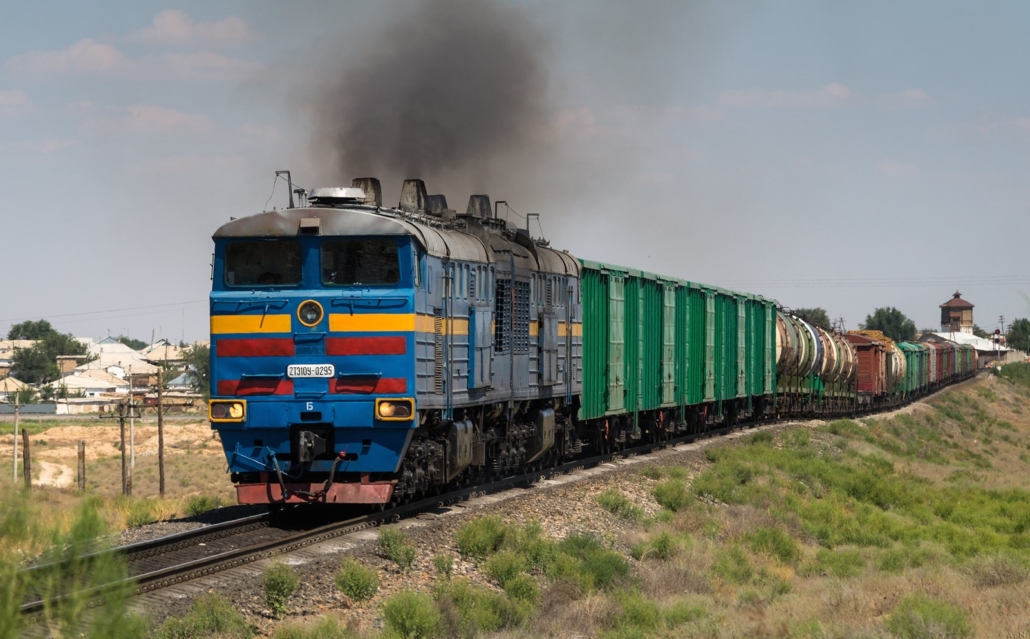
- Kazakhstan is trying to diversify its economy with railroad manufacturing. Kazakhstan is attempting to spend its oil wealth on new industries to offset its heavy dependence on oil. The premier industry is railroad manufacturing. The state-owned railroad empire, Kazakhstan Temir Zholy (KTZ), is aggressively expanding with $3.1 billion invested in 2013. Kazakhstan hopes to become a global leader in railroad production. The industry employed one in every 54 people in 2013.
- Kazakhstan is Central Asia’s breadbasket. Agriculture in Kazakhstan is less than 5 percent of its gross domestic product (GDP) but employs almost one-fifth of its population. As the world’s seventh largest wheat exporter, Kazakhstan is crucial to food security throughout the region. Droughts in Kazakhstan can be devastating, reducing harvests sixfold.
- The state owns and controls most of the broadcast media companies in Kazakhstan. The Kazakh government owns almost all of the radio and TV networks. Cellular telephone and internet usage are on the rise, including a vast 4G network.
- Overall, Kazakhstan has a low number of people below the poverty line. Only 2.6 percent of the entire population is below the internationally standardized poverty line. However, poverty is still a problem, especially in certain regions. Poor housing conditions affected 28 percent of the population, low education rates affected 11 percent and low consumption affected 15 percent.
- Kazakhstan has relied on Russia as a trade partner but is trying to diversify. Kazakhstan exports 78 percent of its oil production. Historically, Kazakhstan has relied on Russia to distribute its oil throughout Europe. More recently it has been trying to grow new trade partnerships, especially with China to counteract over-reliance on Russia.
The above top 10 facts about living conditions in Kazakhstan depict both the struggles and the successes of a young nation. With the help of international partners like the United States Agency for International Development (USAID), Kazakhstan can continue to manage its economic growth and address regional disparities.
– Peter S. Mayer
Photo: Flickr
