• Link to X
  • Link to Facebook
  • Link to Instagram
  • Link to TikTok
  • Link to Youtube
  • About
    • About Us
      • President
      • Board of Directors
      • Board of Advisors
      • Financials
      • Our Methodology
      • Success Tracker
      • Contact
  • Act Now
    • 30 Ways to Help
      • Email Congress
      • Call Congress
      • Volunteer
      • Courses & Certificates
      • Be a Donor
    • Internships
      • In-Office Internships
      • Remote Internships
    • Legislation
      • Politics 101
  • The Blog
  • The Podcast
  • Magazine
  • Donate
  • Click to open the search input field Click to open the search input field Search
  • Menu Menu
Blog - Latest News
Developing Countries, Education, Global Poverty

Education in Cabo Verde Successes: Enrollment
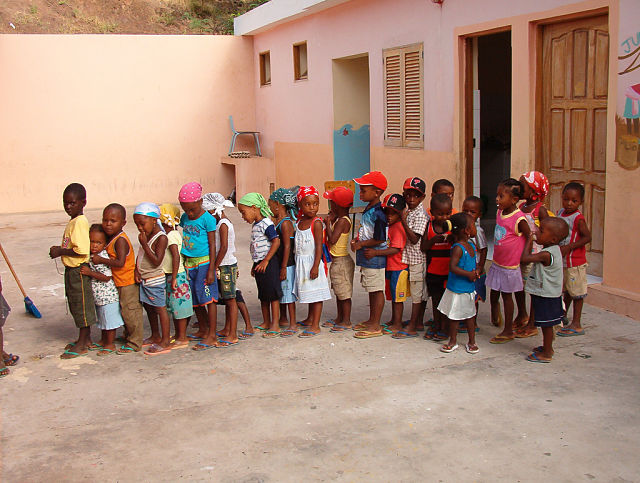
Education in Cabo Verde

Cabo Verde is a small nation that consists of a group of islands just under 400 miles off Africa’s northeast coast. Nine of the 10 islands are inhabited and they are divided into two groups. The Barlavento group in the north includes the islands of Santo Antão, São Vicente, Santa Luzia, São Nicolau, Sal and Boa Vista. The Sotavento group in the south includes the islands of Maio, Santiago, Fogo and Brava.

According to a 2014 report by the World Bank, 3 percent of primary school aged children were not enrolled in school. Girls were less likely to receive an education in Cabo Verde; only 1 percent of primary school aged boys were not in school compared to 4 percent of girls. The rate of completion of primary education in Cabo Verde is 99 percent, which shows that the small nation is making progress towards its goal of universal primary education.

Compared to other low to middle-income nations, access to education in Cabo Verde ranked among the 85th percentile, but it only ranked at the 61st percentile in learning. Despite this, the literacy rate of the youth population was 98 percent, which was higher than the average in other lower to middle-income nations. This is good news for education in Cabo Verde, because literacy is a necessary skill for accessing higher levels of education.

Although Cabo Verde has made great strides in access to education, there are still some obstacles to overcome. One problem for education in Cabo Verde is that many students and teachers alike speak Creole at home and have a weak command of Portuguese, which is the language used in the academic setting. Aside from that, there is not enough spending on supplies, books and lunches, and there is also a high rate of repetition. Students are more likely to repeat grade two during their primary education. The rate of repetition in grade two was 18 percent in Cabo Verde, which was double the average of other primary grades.

Cabo Verde‘s high enrollment and literacy rates show that education is a priority in the country. By addressing its students’ obstacles to learning, it can ensure that they get the most out of the education they are receiving.

– Fernando Vazquez

Photo: Google

November 1, 2017
Share this entry
  • Share on Facebook
  • Share on X
  • Share on WhatsApp
  • Share on Pinterest
  • Share on LinkedIn
  • Share on Tumblr
  • Share on Vk
  • Share on Reddit
  • Share by Mail
https://borgenproject.org/wp-content/uploads/borgen-project-logo.svg 0 0 Borgen Project https://borgenproject.org/wp-content/uploads/borgen-project-logo.svg Borgen Project2017-11-01 07:30:332024-05-29 22:27:56Education in Cabo Verde Successes: Enrollment

Get Smarter

  • Global Poverty 101
  • Global Poverty… The Good News
  • Global Poverty & U.S. Jobs
  • Global Poverty and National Security
  • Innovative Solutions to Poverty
  • Global Poverty & Aid FAQ’s
Search Search

Take Action

  • Call Congress
  • Email Congress
  • Donate
  • 30 Ways to Help
  • Volunteer Ops
  • Internships
  • Courses & Certificates
  • The Podcast
Borgen Project

“The Borgen Project is an incredible nonprofit organization that is addressing poverty and hunger and working towards ending them.”

-The Huffington Post

Inside The Borgen Project

  • Contact
  • About
  • Financials
  • President
  • Board of Directors
  • Board of Advisors

International Links

  • UK Email Parliament
  • UK Donate
  • Canada Email Parliament

Get Smarter

  • Global Poverty 101
  • Global Poverty… The Good News
  • Global Poverty & U.S. Jobs
  • Global Poverty and National Security
  • Innovative Solutions to Poverty
  • Global Poverty & Aid FAQ’s

Ways to Help

  • Call Congress
  • Email Congress
  • Donate
  • 30 Ways to Help
  • Volunteer Ops
  • Internships
  • Courses & Certificates
  • The Podcast
Link to: Why Is There Hunger in Mongolia? Link to: Why Is There Hunger in Mongolia? Why Is There Hunger in Mongolia? Link to: Education in Comoros: Focus on Improving Literacy Link to: Education in Comoros: Focus on Improving Literacy Education in Comoros: Focus on Improving Literacy
Scroll to top Scroll to top Scroll to top