10 Facts About Poverty in North Korea
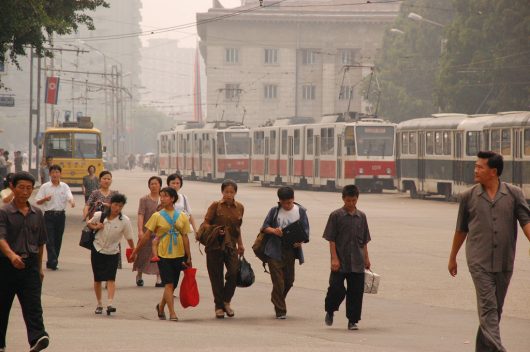
North Korea is constantly in the news due to its nuclear tests programs. The majority of state funds are spent on its nuclear program while social institutions are overlooked. Millions suffer from extreme poverty in North Korea as a result.
10 Leading Facts on Poverty in North Korea
- The poverty line. Forty percent of the population, about 24 million people, live below the poverty line. Most workers earn $2 to $3 per month. The standard of living has deteriorated to extreme levels of deprivation while the average life expectancy has fallen by five years since early the 1980s.
- Food shortages. With the prevalent poverty in North Korea, food shortages are widespread. A famine that started in the 1990s had a lasting effect, forcing the country to become reliant on international aid to feed its people. However, since 2009 food assistance has declined significantly. A study by the United Nations Food and Agriculture Organization found that 84% of households have “borderline or poor food consumption.” The food crises had resulted in thousands of deaths. According to the World Food Programme, one-third of children are stunted due to malnutrition and the infant mortality rate is 33%. Due to the government’s “two meals a day campaign” food riots are a common occurrence.
- The giant rabbit feeding program. In order to solve the widespread food shortages, Kim Jun-il began to breed giant overweight rabbits in 2007. He got this idea after seeing Karl Szmolinsky, a German rabbit breeder, breed the world’s largest rabbit. Szmolinsky sent overweight rabbits to North Korea but the experiment turned out to be a failure when it was suspected Kim was eating the rabbits himself.
- Human feces government program. Farming fertilizers used to be imported from South Korea. However, South Korea stopped sending them in 2008. The government, therefore, created a program where farmers had to use their own feces as fertilizers. Factory workers have to meet a quota of two tons of human feces.
- Right to health is denied. Although the country declares that healthcare is free, residents are denied medical treatment unless they can pay the high prices for medicine.
- Military programs use most of the funds. North Korea spends a lot of its funds on the military. In 2001, the country spent more than $5 billion on military spending alone, which is more than 30% of the country’s GDP. North Korea is believed to have around half a dozen nuclear weapons.
- Despite high poverty rates, the leader is worth $5 billion. According to the 2011 corruption index from Transparency International, North Korea is officially the world’s most corrupt country. It is estimated that Kim inherited $4 billion from his father. According to a South Korean news organization, he is worth as much $5 billion. The money is held in secret accounts in European banks and comes from counterfeiting, the sales of narcotics and other illegal endeavors. Kim also spends vast amounts of money on luxury goods. It is reported he spent $645.8 million in 2012.
- Refugees who are caught are sent to prison labor camps. Leaving the country without official permission is a crime. The government uses the threat of detention and forced labor as repercussions for disobedience. Many families flee to China to seek refuge overseas. However, those that are caught are sent to political prisoner camps. The camps carry out systemic abuse. Death rates at these camps are reportedly very high. U.S. and South Korean officials estimate that between 80,000 to 120,000 people are imprisoned in these camps.
- Crystal meth epidemic. North Korea suffers a widespread meth epidemic. To negate the horrid economy with little to no government help, the production of drugs is used as an economic stimulus. In 2000, North Korean factories began to produce methamphetamine. This caused an increase in the domestic use of meth. The drug is now very occurrence and is seen as something of a luxury. As a result, many North Koreans have become addicted to the drug. It is estimated that 80% of residents have used the drug while 40% are addicted.
- The satire film “The Interview” gets a lot right. According to an expert, the film gets a lot right, specifically the psychology of North Korea. Visitors to Pyongyang in the famine years used to describe supermarkets that displayed plastic produce, just as is portrayed in the film.
Kim Jong Un’s rise to power is seen as a threat to western political leaders. However, the international community has begun to focus on North Korea’s human rights violations and poverty in the country.
– Marcelo Guadiana
Photo: Flickr
