Equal Education in Senegal
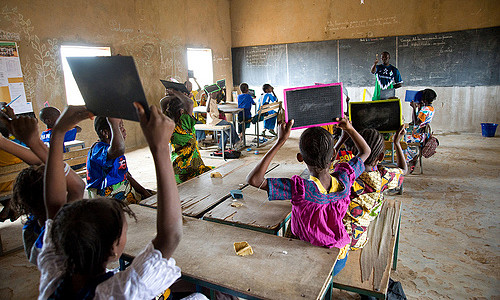 Once known around the world as the finish line of the famous Paris-Dakar Rally, the small West African country of Senegal stands out in from its neighbors. Unlike many of other West African countries like Cote d’Ivoire, Nigeria and Sierra Leone, Senegal has never experienced any notable conflicts or civil war in the last century.
This distinction has helped to garner the country a deserved reputation for high political stability in an often war-torn continent. However, Senegal also lacks the natural resources of many of its African peers and consequentially ranks as one of the poorest nations on earth. According to UNICEF, 22 percent of its population lives on less than a dollar per day.
For the youth of Senegal and for girls in particular, this has hindered the effectiveness of Senegal’s education system. However, the country has experienced a significant improvement in recent years. In 2009, 92.5 percent of Senegalese children attended primary school. This represents a dramatic improvement from 82 percent in 2005 and only 54 percent in 1994.
Yet, this overall progress belies a residual and significant flaw in education in Senegal; in the long run, girls are far more likely than boys to drop out and to receive less education. At a casual glance, however, it might not seem this way. In 2012, primary school enrollment was actually higher for girls than it was for boys at 74 percent and 72 percent respectively.
While the data for primary school enrollment suggests gender parity, this is not actually the case. As the children progress through their schooling, girls experience noticeably lower rates of attendance. This first becomes apparent upon the transition to secondary school. In contrast to 62 percent of their male peers, 57 percent of girls begin secondary school.
The disparity only widens as their education continues. Secondary school enrollment for boys was 34 percent for boys and 27 percent for girls. Ultimately, one can see the results of gender inequality in Senegal’s adult literacy rate; 62 percent of males and only 39 percent of females were literate. For every 10 literate men in Senegal, only 6 women have attained literacy.
These severe and disparate dropout rates reflect the economic challenges that affect poorer families in Senegal. Children frequently must quit their schooling in order to provide more money for their families by working.
This burden falls harder on girls. Often families will marry off daughters at a young age to lessen their economic burden or they will employ them around the house conducting domestic duties. Many will expect to do domestic work for the rest of their lives. This career choice puts girls and women at greater risk of sexual abuse and financial exploitation.
For families of higher economic standing, education in Senegal is less of an issue and more of an expectation. Girls from wealthier households have twice the attendance rate in primary school.
In the city of Dakar, one of the economic pillars of the Senegalese economy, private schools are becoming even more common. In fact, most schools in Dakar are private rather than public. This has created an even greater educational disparity for those without the money to pay for education.
The wealth and gender inequality in secondary education also carries over to higher education.
UNESCO reported that an increasing amount of private institutions has hindered accessibility for many college students. Additionally, more men were enrolled than women as college students. According to the World Bank, for every 10 male college students, there were only 6 female students.
With the help of foreign aid from USAID and The World Bank, Senegal is attempting to develop and expand its education system. Already, funds from USAID have greatly improved education in the nation.
In total, it has allowed for 500,000 children to enroll in school of which 300,000 were girls. USAID has also helped to expand the educational infrastructure of Senegal through the construction of over 100 middle schools. It has donated more than 3 million textbooks and provided 20,000 schoolchildren with internet access.
The World Bank initiated an ongoing project called “Tertiary Education Governance and Financing for Results Project for Senegal” which is aimed at “[enhancing] the efficiency and quality of the higher education system” in Senegal. While the project is not expected to end until 2016, it has already posted impressive results. It found that 88 percent of academic programs fit quality standards in June 2015 with the target set at 90 percent in September 2016.
To lessen gender inequality, UNESCO and the Senegalese government have teamed up to initiate the “Girls and Women’s Literacy in Senegal” program. It aims to provide 40,000 women and girls with high-quality education and more professional opportunities.
More still needs to be done, and with only 750,000 dollars of funding, this initiative cannot single-handedly solve the issue of inequality in Senegal’s education system. With the help of more foreign aid, Senegal can expect further progress.
– Andrew Logan
Sources: The Guardian, Institut de Recherche pour le Développement, UNESCO 1, UNICEF, UNESCO 2, USAID, The World Bank
Photo: Open Equal Free
