Yemen’s Water Crisis
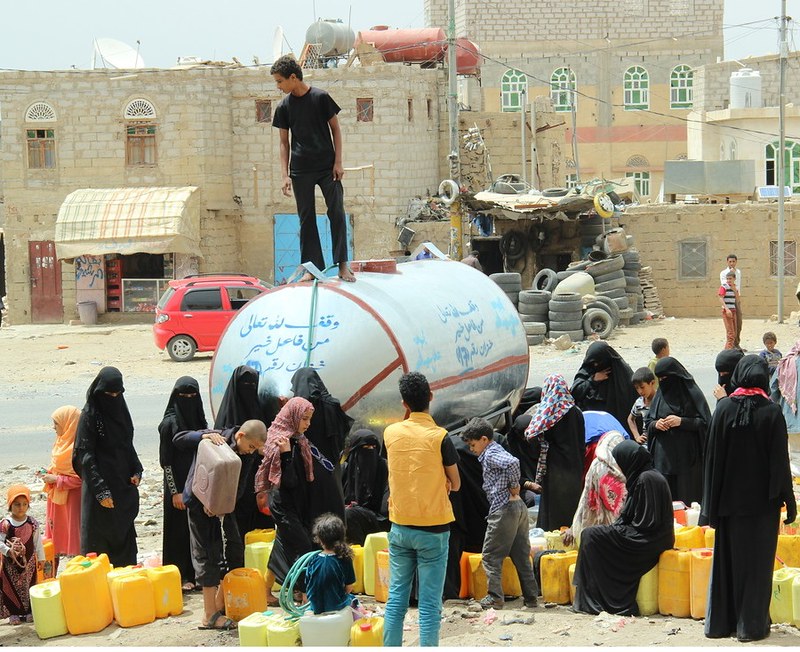 Yemen, strategically located on the Southern Arab peninsula, has a rich history shaped by thousands of years of societal and dynastic changes, resulting in a diverse society. However, modern warfare and harsh weather conditions have contributed to significant water insecurity. In 2023, Human Rights Watch reported that 15.3 million Yemenis face water crisis, while other estimates suggest the number could be as high as 20 million. This makes Yemen one of the most water-scarce countries in the world.
Causes of the Water Crisis
The American Education Global Majority Journal identifies five primary causes for Yemen’s water crisis: high population growth, misguided agricultural policies, water consumption for qat cultivation, lack of law enforcement in water regulation and high vulnerability to climate change. Additionally, the ongoing conflict since 2014 has severely disrupted water and agricultural systems, particularly in peri-urban and internally displaced persons (IDP) areas. It impedes the construction of responsive infrastructure and diverts internal funding away from water projects. Understanding these dynamics is essential for addressing Yemeni security challenges.
Impact of the Water Crisis
The destruction of water and sanitation systems during wartime in Yemen has facilitated the spread of water-borne diseases. For instance, a cholera outbreak in 2016 spread across 19 governorates, affecting 53,000 people and it is estimated that half a million children suffer from diarrhea at any given time. Additionally, UNICEF predicts that 2 million boys and girls in Yemen are denied an education due to the scarcity of wells and flowing water networks. The need to travel miles for water often falls on children, pulling them away from their education. In the Dhamar governorate, for example, the water network has suffered significantly due to limited financial resources and the ongoing crisis, forcing many students to leave school to help fetch water from remote areas to support their families.
Currently, 257,000 hectares of Yemen’s agricultural land reveal signs of distress. Water scarcity not only reduces agricultural production but also exacerbates food and nutrition security issues, leading to widespread health problems. This is compounded by ongoing conflict that has disrupted agrifood systems throughout the country.
Local Efforts to Alleviate Yemen’s Water Crisis
Saba Relief, one of many local charity organizations in Yemen, provides water wells, family water tanks and public water tanks funded by public donations. This support enables families to access water without traveling long distances, freeing up time for other opportunities, such as schooling for children.
International Aid and Technological Innovations
International charities like Muslim Aid USA are leveraging scientific advancements such as solar water disinfection. Unlike conventional well pumps that use grid electricity, a solar-powered pump operates on free energy from the sun. Solar water wells use this solar energy to purify biologically contaminated water, significantly reducing disease risk and bringing stability to communities in drought-prone areas affected by wartime migration.
Another benefit of international involvement is the sharing of techniques and methods to tackle the water crisis in Yemen. For example, the Ministry of Foreign Affairs of the Netherlands has successfully implemented water-saving measures in agricultural practices, reducing usage by 19% from 72.6 cubic meters per hectare a year (approximately the volume of a one-car garage) to 58.56 cubic meters (about twice the volume of a large U-Haul truck) per hectare per year. The project began by importing modern irrigation equipment into the Sana basin. A second ongoing project builds on this success and aims to enhance water use efficiency further.
Strengthening Local Governance and Infrastructure
In 2023, the United Nations (U.N.) initiated the ‘Strengthening Inclusive Local Governance and Peacebuilding in Yemen’ project, which successfully rehabilitated the main water networks in Maghrib Ans and Al-Jadad. Samira Al-Qanoun, member of the Consultation Committee in Dhamar Governorate, praised the project, noting, “The rehabilitation of the network allows us access to clean and safe water, enhances our community safety and improves the overall living conditions of families.” Currently serving 420 households, the newly rehabilitated water network is set to expand service to more than 800 households, setting the stage for future community projects supported by international aid.
Toward a Sustainable Solution
As stated by Ahmed Ali Al-Dourani “We cannot achieve peace without providing access to clean and safe water to every community member.” Efforts to combat Yemen’s water crisis reveal promise through local initiatives and crucial international support. By continuing to embrace technological innovations and strengthening governance, Yemen could further enhance water access for its citizens.
– Kathryn Dodd
Kathryn is based in the UK and focuses on Global Health for The Borgen Project.
Photo: Flickr
