Waste Management in Cairo: An Informal Success
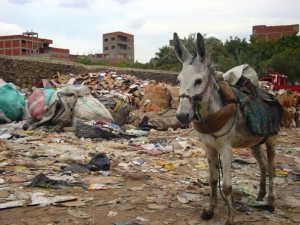 Cairo, a city of roughly 20 million people, produces more than 15,000 tons of solid waste every day. Even though the government funds some formal sector waste management, much of the time it relies heavily on the local poor. Since it is these neighborhoods that are often deemed “too expensive” for waste collection, the local individuals are burdened with the task of handling the solid waste.
Effective Methods
Zabbaleen, or Garbage People, spend their days sifting, sorting and transporting waste. Despite this arduous and tedious work, the locals have found methods of waste management in Cairo that arguably surpasses formal sector methods. In fact, according to the Environmental Protection Association of Pollution, they recycle about 85 percent of the city’s waste—more than is even seen in North American and European cities.
The economic returns from informal waste management in Cairo are high, and thus it is a sector that requires proper facilitation in order to protect its workers.
Positive Impacts
Many firms purchase recycled materials at a lower rate than virgin resources which gives them a competitive edge. Zabbaleen are self-employed meaning they are lowering the overall unemployment rate in Cairo. In fact, globally, more than 15 million people rely on waste collection for employment. Organic waste diverted from dumpsites helps to feed local animals.
Negative Impacts
Children are kept home from school help with sorting thus they miss out on educational opportunities in exchange for immediate income. In Egypt, the net number of children enrolled in primary school is increasing, but Zabbaleen are among those least likely to attend. Exposure to toxins make Zabbaleen highly susceptible to diseases such as the Hepatitis C Virus (HCV) which can be contracted from improperly disposed medical waste. Zabbaleen do not receive job benefits or protection despite being service providers to the city. The Association for the Protection of the Environment notes that although these workers help sort through 40 percent of the city’s waste, it is at no cost to the city.
Zabbaleen are integral to waste management in Cairo. In regions where formal infrastructure is not effective, these individuals are essential in reducing rates of pollution, providing jobs, and selling goods back to the market at a discounted price. Since Cairo does not directly fund these individuals, they rely on the help of outside organizations and firms to support them.
The World Bank funded a project in 2014 called the Cairo Municipal Solid Waste Management Project to help the country achieve environmental and development goals while recovering from residual economic hardship from the shocks in 2011. Since the population grew at such a rapid pace, the initiative strived to restore macroeconomic stability in order to help reduce extreme rates of poverty in the Delta and Upper-Egypt regions.
Organization to Empower
The Zabbaleen themselves run an organization that supports garbage collectors. The Association for the Protection of the Environment (APE), established in 1984, assists marginalized groups in their journey to reducing waste and raising the living standards of their community. One of their vital projects helps to treat individuals exposed to the Hepatitis C Virus from improperly disposed of medical waste. Egypt experiences some of the highest levels of HCV in the world with approximately 150,000 people infected each year according to the World Bank. About three tonnes of medical waste is generated daily, and much of it is simply disposed with municipal waste—putting Zabbaleen at risk.
Garbage collection in any large metropolitan area is critical to the survival and economic advancement of that city. As a result, it is crucial to include and recognize informal sector participation when creating policies and allocating funding. Locals are the most knowledgeable about their cities, thus governments will benefit from recognizing and heralding this expertise in order to support effective waste management in Cairo. The economic returns of garbage collection are high, so funding and supporting the workers will subsequently help reduce poverty in the region.
– Tera Hofmann
Photo: Wikimedia
