Inside the Project Designed To Improve Thai Infrastructure
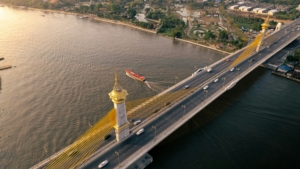 The Thailand Resilient Transport Connectivity and Irrawaddy Dolphin Conservation Project (TRIP) will improve Thai infrastructure and protect local biodiversity in the Songkhla Lake region through the strategic construction of two new bridges. Last spring, the International Bank for Reconstruction and Development (IBRD) approved funding for the project. The World Bank published a disclosure on May 25, 2025, announcing its $144.76 million loan commitment, marking the organization’s first significant lending operation in the country in more than 15 years.
In a press release, the World Bank’s Division Director for Myanmar and Thailand, Melinda Good, said, “This project marks a significant milestone in our renewed partnership with Thailand—bringing critical infrastructure to local communities while protecting the country’s unique natural assets that support local economies.”
Connecting Communities
TRIP promises to connect communities in the Songkhla Lake region through the construction of two new, crucially weather-resistant bridges. According to plans, the new Songkhla Lake Bridge will link Songkhla and Phatthalung provinces via a seven-kilometer roadway across Songkhla Lake. At present, an 80-kilometer or roughly two-hour, detour stands in the path of travelers between the two regions.
TRIP aims to reduce this journey to a mere 10 minutes. Additional plans include the construction of the Kho Lanta Bridge, a two-kilometer roadway connecting Krabi on the mainland to Koh Lanta, a Songkhla Lake island. Kwanpadh Suddhi-Dhamakit, a senior officer for Thailand at the World Bank, stressed in a social media post last month that plans consider the region’s environmental challenges and draw on examples of past natural disasters.
Indeed, southern Thailand’s climate dictates that both bridges incorporate weather-resilient engineering in their design. Floods, storms and sea-level rise all pose distinct threats to communities around Songkhla Lake in the coming years. The presence of the Kho Lanta and Songkhla Lake bridges strengthens future evacuation routes for local communities.
Economic Importance
On the project, Suddhi-Dhamakit said, “Improved connectivity is expected to support job creation during construction and long-term employment through tourism and local economic activity.” In this way, TRIP holds significant economic importance for the areas surrounding Songkhla Lake. Southern Thailand’s economic growth trails behind that of the rest of the country.
The poverty rate there is 7.4%, more than double the national average. Connectivity plays an important role in the job market because transportation bottlenecks can impede the ability of residents to attend markets and access services and other employment opportunities. The construction of the two new bridges stands to benefit the local population initially by providing construction jobs.
It will later allow easier access to other employment through improved transportation infrastructure. Three million tourists also pass through the region each year, a number experts expect to rise with the area’s improved travel connections.
Final Thoughts
While the project remains in its infancy, support from the World Bank represents a monumental step toward its eventual realization. Negative environmental trade-offs often materialize in large-scale infrastructure development, such as what TRIP proposes. Nonetheless, the project aims to bridge the gap by simultaneously developing Thai infrastructure and protecting local biodiversity.
– Louis Sartori
Louis is based in London, UK and focuses on Good News and Technology for The Borgen Project.
Photo: Unsplash
