The Grand Ethiopian Renaissance Dam: Powering a Nation
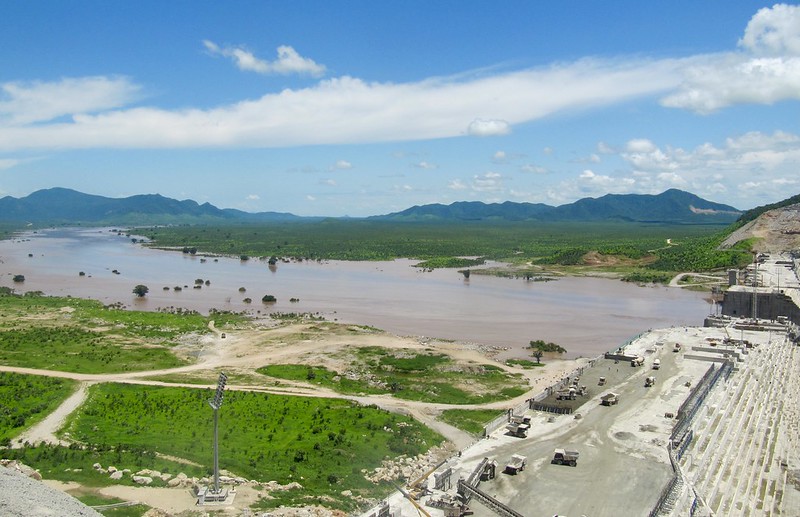 The Grand Ethiopian Renaissance Dam (GERD) was named to reflect Ethiopia’s ambitions for national renewal and economic growth. As Africa’s largest hydroelectric power plant, the expectation is to expand electricity access in a country where more than 60 million people lack power and millions more live in poverty. While the GERD often receives praise for its potential to alleviate poverty within Ethiopia, its potential to promote development across the entire Nile Basin does not get as much emphasis.
Building the Grand Ethiopian Renaissance Dam
In 2011, Ethiopia announced its plans to construct GERD on the Blue Nile. The $4.8 billion dam, funded primarily by the Ethiopian people through government-issued bonds, quickly became much more than just a standard infrastructure project. With a planned power capacity of 5,150 megawatts, GERD promised to lift countless Ethiopians out of darkness and poverty – and into a better future.
Ethiopia is among the world’s poorest countries, with 67.14% of its population classified as multidimensionally poor. It also has one of the largest electricity access deficits. As of 2022, only 55% of Ethiopians had electricity, leaving millions in energy poverty on top of economic hardship. This reality is not only a symptom of widespread poverty but a perpetuator of it.
Without power, two-thirds of Ethiopian children struggle to study after dark. Women and girls spend hours gathering firewood and cooking over open stoves, losing time to pursue education or work. And patients are deprived of lifesaving equipment and treatment. For exactly these reasons, GERD, with its ability to double Ethiopia’s energy output, is a beacon of possibility. It offers a concrete path to power, education and development to a nation long denied all three.
Conflict on the Nile
Miles downstream, however, many fear that the dam guarantees the exact opposite. Egypt, a country that relies on the Nile for approximately 90% of its water needs, sees the prospect of reduced flow as a threat to its very survival. While Ethiopia frames the dam as an existential necessity, Egypt insists it is an existential threat.
These dichotomous perspectives lie at the heart of the Nile dispute, a centuries-old debate over who has the right to own and control the river. Unfortunately, the Nile has often been a source of division instead of unity. Ethiopia, Egypt and the other riparian countries have struggled to find a compromise when it comes to water allocation. Yet the needs of the different parties may not be as incompatible as they appear.
Collaboration Over Conflict
In a study published in Nature, water resources expert Mohammed Basheer of the University of Toronto and his team argue that collaboration could leave the Nile Basin as a whole better off. If managed efficiently, GERD can help Egypt meet its water needs during times of scarcity while generating hydroelectric power for Ethiopia when river flows are strong.
The study’s modeling shows that the GERD can serve to meet the individual needs of different countries, rather than making those needs mutually exclusive. Just as it can generate hydropower to spur economic growth and development in Ethiopia, the dam can also reduce irrigation deficits in Egypt, boosting agriculture and production in other water-dependent industries.
Fostering Unity Through Music
Basheer and his team make a clear case for cooperation, but they are not alone. Though their medium is very different, The Nile Project – a musical and educational initiative – reaches the same conclusion: harmony is key to a prosperous future.
Founded to inspire collaboration, The Nile Project brings together musicians from various riparian countries. The artists blend their languages and cultures, creating a unique sound and reminding audiences both regionally and abroad of the value in working together. By promoting the Nile as a point of connection rather than division, the organization helps build the cultural foundation needed for shared economic benefit.
Building a Shared Future
Resolving conflict and reaching a compromise is often challenging, but by choosing cooperation, Nile Basin countries could see positive results. Expert opinions suggest that GERD is unquestionably crucial to Ethiopia’s development and with the right approach, it could be a key tool in the fight against poverty across the entire region.
– Caroline Clark
Caroline is based in Needham, MA, USA and focuses on Global Health and Politics for The Borgen Project.
Photo: Flickr
