Reducing Food Loss, Waste and Meat Consumption Could End World Hunger by 2030
The United Nations has called for the end of world hunger by 2030 in its Sustainable Development Goals (SDGs). In Goal 2, of 17, the UN outlines the need for the promotion of sustainable agriculture that will improve food security and nutrition while protecting the ecosystem and fighting climate change. Although a tall order, the United Nations Food and Agriculture Organization (FAO) along with the Austrian think tank, International Institute for Applied Systems Analysis, believes that the goal is attainable.
“I don’t think it’s all that ambitious to eliminate hunger,” said Jomo Sundaram, assistant director-general of the UN’s Food and Agriculture Organisation (FAO). He told Reuters he attributes his optimism to rising incomes in much of the world, improvements in the transportation of food, and new technologies that are keeping yields of many key crops on an upward trend.
But in order to achieve the goal of eliminating world hunger, food waste and the inefficiencies of the livestock industry need to be addressed.
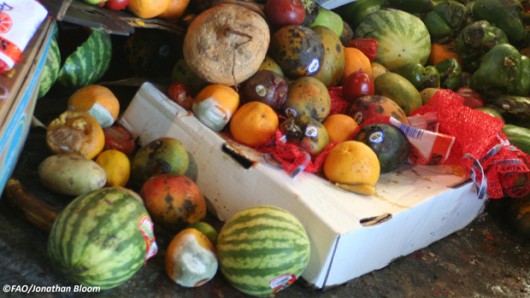
Despite the fact that there is currently enough food produced globally to end world hunger, much loss and waste occur postharvest. According to the World Resources Institute (WRI), about 24 percent of all calories currently produced for human consumption are either lost or wasted.

The WRI reports that by reducing postharvest losses there will be more food available to farmers and communities, making food more affordable and accessible to the poor and food insecure. This can be done, the group states, through attainable solutions for developing nations such as pest-resistant packaging and cooling-cellar storage.
Changing dietary habits is another important solution to ending global hunger, particularly shifting from raising cattle as a source of protein to growing fruit, grain, and vegetables. According to the FAO, the amount of human-edible protein that goes into raising livestock is higher than the human-edible protein yielded from livestock. The group estimates that 26 percent of the world’s land that is being used for livestock grazing could produce better and more nutritionally valuable yields if converted to growing plant-based food for human consumption.
In addition to increasing the yield of protein-rich crops, reducing the number of grazing livestock, particularly cows, will also lower annual greenhouse gas emissions. According to the FAO, “Livestock contributes both directly and indirectly to climate change through the emissions of greenhouse gases such as carbon dioxide, methane and nitrous oxide.” The FAO estimates that 18 percent of global greenhouse gas emissions come from livestock.
By implementing better waste prevention systems and simply eating less meat from grazing animals, the fight against global food insecurity could indeed be attainable.
– Claire Colby
Sources: Food and Agriculture Organization 1, Food and Agriculture Organization 2, Huffpost Impact, The Physics Factbook, The World Bank, The World Factbook 1, The World Factbook 2, The World Factbook 3, World Resources Institute
Photo: fao
