How Climate Instability Affects Pastoralism in the Sahel Region
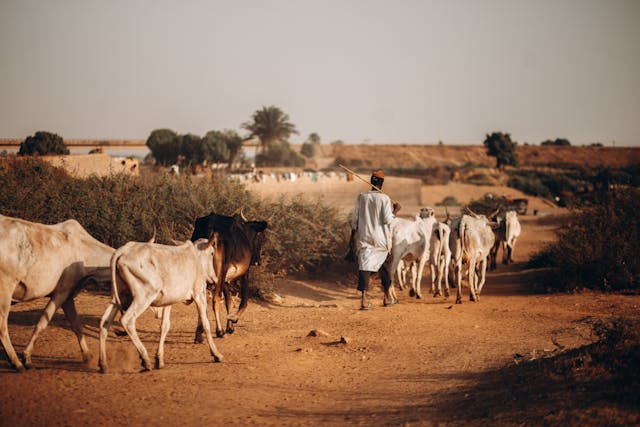 Climate instability is slowly but consistently making life in the Sahel harder for herders, whose livelihoods depend on rainfall, pasture and mobility. Rising temperatures, erratic rains and longer dry seasons are shrinking grazing land, drying water points and forcing pastoralists to move farther and more often in search of survival.
A Fragile Way of Life
For centuries, pastoralism has been a strategy for adapting to the dry environment of the Sahel region. Herders move livestock across wide areas so animals can find new pasture and the land can recover. However, that system only works when mobility remains possible and water is not scarce.
Changing climatic conditions in the Sahel are disrupting both. Rainy seasons are less predictable, droughts are becoming more severe and springs and streams that once sustained herds are disappearing. These changes do not just reduce income; they threaten an entire social and economic system.
In the Sudano-Sahel region, more than 20 million people depend on pastoralism for survival and livestock is often the main source of food, cash and status. When grass fails or water holes dry up, families lose animals, nutrition worsens and their ability to recover from shocks weakens. These difficulties affect not only people who live off livestock but also farmers who grow crops for the animals.
Drought and Loss
The human and economic costs of drought can be devastating. One major drought in Niger in 2010 killed more than 4.8 million cattle, roughly a quarter of the country’s herd, causing losses of more than $700 million. For herding families, such losses are not abstract statistics.
They translate into lower school fees, less milk for children and the collapse of savings built up over years, if not generations, through entire flocks. Pastoralism in the Sahel region is also harmed by diseases and herd weakness caused by climate stress. As animals are concentrated into smaller areas with less fodder, they become more vulnerable to illness and malnutrition.
At the same time, governments may impose tighter controls on animal movement due to concerns about livestock disease, making it even harder for herders to follow the rains and preserve their herds. Additionally, longer transhumances may expose animals to stress, disease vectors (such as ticks and flies) and consequential zoonotic diseases. This is not only an issue for animal health but also for humans, increasing the transmission of infectious diseases such as brucellosis and tuberculosis.
Tensions Over Land
As pasture disappears, herders are increasingly pushed into zones where farming is expanding, especially in the southern Sahel. This creates competition over land and water between farmers and herders, a pressure that can turn local disputes into small armed conflicts when land-use rules are weak or unenforced. Climate emergency does not cause every conflict in the Sahel, but it intensifies competition over scarce resources and makes peaceful coexistence more difficult.
Mobility, once a strength of pastoral systems, is becoming harder to sustain. Fragmented landscapes, insecurity and armed groups on transhumance routes can trap herders in unsafe or overused areas. This is further worsened by the growing availability of weapons and by political entities in the region exploiting these issues.
When families can no longer move freely, they face more grazing pressure, more conflict and fewer ways to adapt.
The PRAPS-2 Strategy
Sahelian governments and regional stakeholders are already collaborating to address shared environmental and economic challenges that endanger pastoralism in the Sahel. In addition to flagship efforts like the Great Green Wall, smaller-scale initiatives such as the Lake Chad Basin Commission and the Lake Victoria Basin Commission aim to improve the management and restoration of transboundary natural resources.
The most important of these initiatives, specifically designed to address pastoral needs, is the PRAPS-2 project. It is based on strengthening national responses while reinforcing regional coordination. Its objective is twofold. First, it seeks to enhance regional coherence in natural resource governance, support the implementation of national regulations and facilitate cross-border trade.
Second, it aims to generate and disseminate scientific and technical knowledge that supports sustainable pastoral practices and informs both national and regional strategies, recognizing their economic, social and environmental significance. Regionally, the program is implemented by the Permanent Interstate Committee for Drought Control in the Sahel (CILSS). The CILSS oversees coordination under the political leadership of the Economic Community of West African States (ECOWAS) and the West African Economic and Monetary Union (WAEMU).
At the national level, implementation is led by the relevant ministries responsible for livestock or rural development across the six participating countries. PRAPS-2 is structured around five core components:
- Improving animal health and veterinary drug control
- Promoting sustainable landscape management and governance
- Strengthening livestock value chains
- Enhancing social and economic inclusion, particularly for women and youth
- Supporting project coordination, institutional capacity and crisis prevention and response
Progress is being made, but this crisis highlights how rising temperatures can deepen insecurity and instability in already fragile regions, making the protection of pastoral livelihoods essential for sustaining resilience, dignity and peace.
– Riccardo Chiaraluce
Riccardo is based in London, UK and focuses on Politics for The Borgen Project.
Photo: Pexels
