Natural Disaster Resilience Policies to Protect the Impoverished
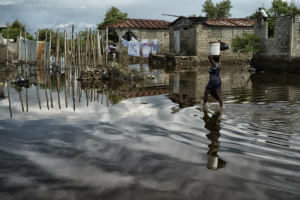
Not only do natural disasters cost the global economy $520 billion annually but extreme weather also thrusts 26 million global citizens into poverty annually. People enduring poverty experience the adverse effects of floods, earthquakes and other natural disasters more severely because they often live in “fragile housing in disaster-prone areas” and take up employment in industries, such as “farming and agriculture,” that are more “susceptible to extreme weather events.” In response to extreme weather and the impact it has on vulnerable populations, the World Bank and the Global Facility for Disaster Reduction and Recovery (GFDRR) released a report that puts forth the idea of natural disaster resilience policies to protect the impoverished from natural disasters and help them to cope with the consequences. The suggestions in this report to the 2016 U.N. Climate Change Conference aim to implement early warning systems and improve access to personal banking, social protection systems and other critical investments.
What are Natural Disaster Resilience Policies?
The purpose of a resilience policy is to help those living in developing countries develop resilience, which refers to “the ability of individuals, communities and states and their institutions to absorb and recover from shocks [while] positively adapting and transforming their structures and means for living in the face of long-term changes and uncertainty.”
With calls for a resilience policy package, specific countries can tackle the financial strain that comes after a natural disaster. For instance, in September 2020, Haiti received a payout of about $7 million “on its Excess Rainfall (XSR) parametric insurance policy following the passage of Tropical Cyclone Laura.” By having their own resilience policies, developing countries can help their most impoverished citizens in the aftermath of natural disasters.
The nature of insurance policies introduced under the resilience policy benefits those facing the impacts of natural disasters by paying out automatically when conditions “meet or exceed pre-agreed thresholds” regarding wind speed, rainfall or economic losses through insurance policies called parametric policies.
The Economic Benefits of Resilience Policies
The World Bank and GFDRR’s suggestions for resilience policies propose improving disaster risk management (DRM) in 117 countries. For instance, Angola, a country in Central Africa, could potentially see “$160 million a year in gains” if the country were to implement “scalable safety nets” to support the nation’s most impoverished citizens in the aftermath of a natural disaster. Countries with resilience policies are already noting benefits. Due to “an innovative insurance program, Haiti, Barbados, Saint Lucia and St. Vincent and the Grenadines received a payout of $29 million in support of recovery efforts after suffering the effects of Hurricane Matthew.”
Scalable safety nets must consist of flexible systems and procedures, including registration and payment mechanisms that will “enable the safety net [to] increase (and decrease) assistance when appropriate” and provide “good quality risk information to understand when a shock has occurred” to allow contingency planning to provide the disbursement of the fund after a disaster.
How Governments Can Assist
Governments can help end global poverty and support those in developing countries after a natural disaster through investments in infrastructure and developing appropriate land-use policies and building regulations. The U.S. Agency for International Development intends to utilize disaster risk reduction (DRR) programs to achieve resilience in countries experiencing extreme weather conditions. Striving for longer-term prevention, the DRR programs will focus on attaining objectives such as “prioritizing and strengthening early warning, preparedness, mitigation and prevention” and “transitions to foster resilience and [support] diversified livelihood strategies” to help impoverished people withstand extreme weather and the impact of natural disasters.
Natural disaster resilience policies can provide better housing and create better employment opportunities for those living in poverty by diversifying the workforce. For instance, in Uganda, “72% of [Uganda’s] labor force works in agriculture,” which is an area that is “highly climate-sensitive.” This puts one of Uganda’s main exports, coffee, at risk in the face of natural disasters or extreme weather events that could potentially prevent the country from producing and harvesting its export. Droughts in 2020 led to the loss of about 50% “of all coffee yields” in Uganda.
By reducing the impact of natural disasters on communities worldwide through resilience policies, poverty can decrease as countries will be better able to adapt to extreme weather changes “and boost the resilience and prosperity of their most vulnerable citizens.” With the ability “to cope, rebuild and rebound,” millions of people can remain out of poverty.
– Grace Watson
Photo: Flickr
