4 Ways Kuwait Vision 2035 Supports Global Poverty Reduction
 While Kuwait is known for its vast oil wealth, the country is diversifying its economy and shaping global poverty reduction through its national development plan. Kuwait’s Vision 2035 reflects a broader shift among Gulf states to expand their economic role and reduce poverty in developing countries, particularly in the Middle East and North Africa (MENA) region, where poverty remains a persistent challenge. While extreme poverty rates in the region are lower than in sub-Saharan Africa, millions still face unemployment, displacement and limited access to basic human services. These are issues that Kuwait’s Vision 2035 addresses directly in four ways.
Development Financing Through the Kuwait Fund
Infrastructure in developing countries is sorely lacking, restricting economies and increasing health risks across regions. In many parts of the developing world, hundreds of millions of people still lack reliable electricity, while billions remain without consistent access to transportation networks or digital connectivity, limiting access to jobs, health care and education. Infrastructure planning in the MENA region often stalls due to insufficient funding.
Kuwait addresses this gap through the Kuwait Fund for Arab Economic Development (KFAED). The KFAED provides concessional loans and grants to finance infrastructure projects in developing countries, including transportation, water systems and energy access. Further, the Kuwait Vision 2035 initiative builds on Kuwait’s use of the Arab Economic Development Fund.
Domestic Infrastructure and Regional Trade Expansion
Roughly 90% of Kuwait’s government revenue and 95% of its exports are due to its heavy dependence on oil. This puts the country in a vulnerable position, as it must continuously adjust to the volatile shifts in global energy demand. To diversify the economy and position the country as a regional commercial hub, part of Kuwait Vision 2035 focuses on expanding domestic funding for more than 90 projects.
This includes expanding ports such as Mubarak al Kabeer and national rail and projects such as Silk City, a massive mixed-use area serving as a global hub for trade and finance. By expanding infrastructure and funding for these projects, Kuwait increases economic opportunity for neighboring countries, many of which are still developing.
Economic Diversification and Foreign Investment Growth
While Kuwait has made progress in improving its living standards, overdependence on oil revenue has limited economic diversification. Home to the seventh-largest oil reserves in the world, oil allows the state to fund a large public sector in which a staggering 80% to 90% of Kuwaiti nationals are employed.
To address overdependence on oil, Kuwait Vision 2035 promotes private-sector involvement by encouraging public-private partnerships to fund large projects. These partnerships support private-sector industrial development and bring additional funding to public projects, reducing reliance on oil revenues. By expanding its private sector, Kuwait attracts foreign investment and regional economic activity.
Humanitarian Aid and Crisis Response
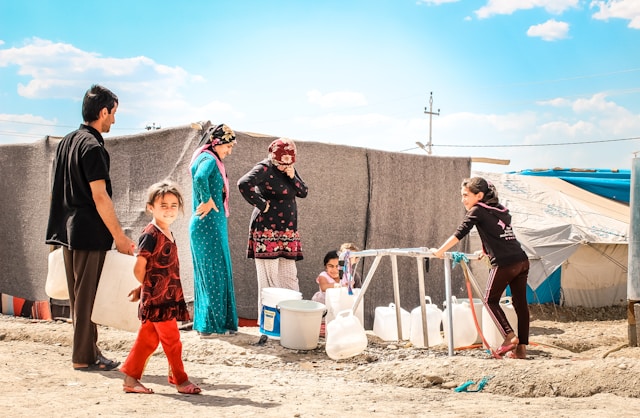
As of 2026, the MENA region is home to more than 24 million people affected by conflict-driven displacement, including millions of refugees. To address the humanitarian crisis, Kuwait has strengthened its global role through the “Global Positioning” pillar of Kuwait Vision 2035, which emphasizes international cooperation and humanitarian leadership. This includes continued financial support for refugee assistance, food security and emergency relief efforts in conflict-affected regions, often in coordination with the United Nations.
Final Remarks
As Kuwait continues to implement Kuwait Vision 2035, the initiative demonstrates how economic strategy can extend beyond a country’s domestic growth to influence global poverty reduction. Through development financing, infrastructure investment, economic diversification and humanitarian aid, Kuwait is expanding its role in addressing the conditions that drive poverty in developing regions.
– Kale Overton
Kale is based in Ames, IA, USA and focuses on Good News and Politics for The Borgen Project.
Photo: Unsplash
