Fragility and Rule of Law in Nigeria
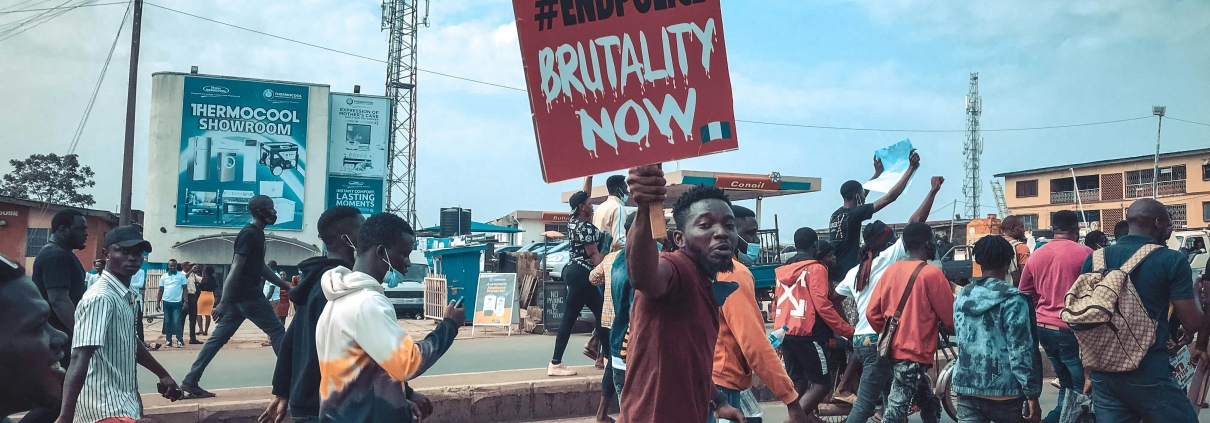 Fragility in Nigeria is closely linked to persistent weaknesses in the rule of law, shaped by insecurity, institutional capacity gaps and challenges in legal enforcement. The justice and security sectors face structural constraints, including resource shortages, case backlogs, corruption and limited accountability mechanisms. These challenges are compounded by incidents in which state security actors themselves have been implicated in rights violations, further weakening institutional legitimacy. Fiscal pressures and governance bottlenecks have constrained the state’s ability to deliver consistent, equitable justice across regions.
In response, institutional reforms and active interventions are underway with a focus on police professionalization, human-rights-based policing and justice system capacity building. Complementary civil society initiatives work to expand access to justice, reduce pre-trial detention and improve legal awareness among vulnerable populations. Together, these efforts illustrate ongoing attempts to strengthen rule of law and reduce fragility in Nigeria. However, their long-term effectiveness will depend on sustained political commitment, adequate financing and coordinated implementation.
Fragility and Rule of Law in Nigeria
According to independent assessments, Nigeria’s rule of law remains weak by global standards. In the 2025 World Justice Project (WJP) Rule of Law Index, Nigeria ranked 120th out of 143 countries and 23rd out of 34 sub-Saharan African countries. This highlights systemic challenges in accountability, public security and the protection of rights.
The Index evaluates eight key dimensions: Constraints on Government Powers, Order and Security, Open Government, Absence of Corruption, Regulatory Enforcement, Civil Justice, Fundamental Rights and Criminal Justice. Nigeria’s particularly low performance in Order and Security reflects widespread insecurity and limited state control over violence.
These findings align with broader governance indicators. The Mo Ibrahim Index ranks Nigeria 33rd out of 53 African countries, with a score of 45.7. It notes a decline in security and rule-of-law indicators between 2014 and 2023.
Security Crises Undermining Rule of Law
Fragility in Nigeria is most visible in the security sector. Armed groups, including Islamic State West Africa Province (ISWAP) and Boko Haram, alongside criminal networks, continue to operate across regions such as the northwest and north-central. These groups contribute to killings, kidnappings and widespread instability.
In February 2026, an attack in Kwara State reportedly resulted in the deaths of more than 170 villagers during clashes involving militant groups attempting to impose extremist control. The actions of state actors have also raised concerns. In December 2025, Nigerian Army personnel opened fire on protesters in Adamawa State, killing nine women and prompting condemnation over excessive force and lack of accountability.
These incidents demonstrate how both nonstate violence and state impunity erode legal structures and public confidence in governance institutions.
Structural Challenges Within Governance and Justice
Multiple structural weaknesses continue to undermine Nigeria’s rule of law. Corruption and impunity remain significant barriers. The World Justice Project estimates that corruption has cost Nigeria more than $550 billion since independence, weakening both legal enforcement and economic development.
Institutional capacity gaps further complicate enforcement. Security agencies, courts and law enforcement bodies often lack adequate resources, training and accountability systems. The United Nations Development Program (UNDP) notes that high crime levels and limited capacity overburden Nigeria’s justice system.
Civil liberties concerns also persist. Restrictions on dissent and shrinking civic space have been identified as threats to democratic governance and the rule of law. Despite constitutional guarantees of equality before the law and fair hearing, judicial delays and weak enforcement mechanisms continue to undermine legal legitimacy.
Active Solutions and Institutional Reforms
Efforts are underway to strengthen Nigeria’s rule of law through institutional reforms and civil society engagement. The UNDP, through its Global Program for Strengthening the Rule of Law, Human Rights, Justice and Security (2022–2025), has partnered with Nigerian authorities to enhance institutional capacity, promote human-rights-based policing and support legal reforms.
In 2023, the UNDP collaborated with the Police Service Commission to implement a strategic plan (2024–2025). The plan included training approximately 1,200 police trainers in human rights, gender-sensitive policing and intelligence management. Nigeria has also drafted a National Action Plan on Business and Human Rights, integrating rights-based governance into national policy frameworks.
Civil society organizations are also contributing significantly:
- Citizens’ Gavel uses technology to improve court transparency and connect vulnerable individuals with pro bono legal services, helping reduce delays.
- Hope Behind Bars Africa provides legal aid to pretrial detainees, supporting prison decongestion and accelerating justice processes.
- The Policy and Legal Advocacy Center (PLAC) promotes legislative transparency and civic engagement.
- The Network Against Corruption and Trafficking (NACAT) focuses on anti-corruption and anti-trafficking advocacy.
These initiatives strengthen accountability and expand access to justice across Nigeria.
Policy Implications and Prospects for Stability
Strengthening judicial independence, improving rights-based policing and expanding civic participation are essential for reversing Nigeria’s fragility trends. However, progress will depend on sustained political will, consistent funding and effective coordination across institutions. Without these, structural challenges, particularly insecurity, fiscal constraints and governance inefficiencies, will continue to hinder the full realization of the rule of law.
– Felix Umeobi
Felix is based in Nigeria and focuses on Politics for The Borgen Project.
Photo: Unsplash
