Women in Fisheries in Sri Lanka: From Wreckage to Renewal
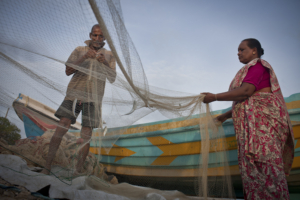 The Indian Ocean tsunami tore through Sri Lanka’s coast in 2004, destroying not only boats and nets but also the very social safety nets that kept the economy afloat. During the loss, women in fisheries in Sri Lanka stepped up. They organized a framework to provide mutual aid circles that transformed into cooperatives that process dried fish, market shellfish and advocate for the waters that feed their families.
Only two decades later, many of these groups are now stable, central businesses that have become anchors in the community. These women didn’t just survive; they changed who held power in coastal life. According to Sri Lanka’s Secretary of the Ministry of Disaster Management, S.S. Miyanawala, “Therefore, it is necessary to change the way we ‘invest.’ We need to focus not only on addressing the consequences of disasters but on reducing the underlying causes of vulnerabilities and enhancing the preparedness and resilience of people and communities.”
Mutual Aid To Market Power
In the early days of Sri Lanka, women traditionally leveraged skills such as salting, sun-drying and selling items to support household incomes. A comparative study from Ambalangoda shows households with women in fisheries in Sri Lanka differed significantly from those who chose not to, showing increased income and access to credit.
By formalizing into cooperatives, these networks evolved into small enterprises and some partnered with NGOs to reach better markets. After the war and tsunami, initiatives in Jaffna educated widows, showing them how to produce higher-quality dried fish for fair-trade outlets, turning a coping strategy into dignified work with a generous return. Today, dried fish remains a crucial, affordable protein for low-income households, stabilizing local demand while co-ops experiment with better processing and quality control.
Measurable Advances in Gender Equity
Women in fisheries in Sri Lanka have become symbols of economic resilience and their leadership has brought new skills, leverage and measurable gains in gender equity. WorldFish’s synthesis on women’s empowerment in small-scale fisheries outlines four pathways: embedding gender in every innovation stage, strengthening agency and leadership, improving resource access and transforming norms through collective action. These are the levers Sri Lankan co-ops pull, from leadership training to negotiating landing-site space and prices.
Sri Lanka’s dried-fish sector adds a vital dimension: well-being. Women’s control over processing and trade shapes income, social dignity, mobility and decision-making. Outcomes ripple into children’s education and household resilience. In a system still marked by informality and gendered barriers, collective organizing is the difference between uncertainty and progress. These cooperatives aren’t only about sales and personal growth.
They’re also about cultivating and repairing reefs, lagoons and mangroves. In Puttalam District and beyond, women’s groups tied micro-enterprises to ecosystem repair, focused on replanting mangroves, monitoring nurseries and campaigning for local protections. That work reduces storm surge, improves water quality and shelters juvenile fish, all classic “nature as infrastructure” benefits that make both catches and communities more resilient to the next shock.
Why It Matters Now
With supply chains evolving and climate extremes intensifying, Sri Lanka offers a living lab for community-first recovery. U.N. and national analyses of post-tsunami reconstruction emphasize community decision-making and moving recovery efforts locally. Women’s cooperatives became durable nodes in that local governance fabric because they knit income, care work and conservation.
International guidance has caught up with what these fishers practiced out of necessity. The FAO’s handbook on gender-equitable small-scale fisheries governance urges countries to center women in rules, markets and services. This approach is reflected in Sri Lankan co-ops that negotiate access to space, credit and training while advocating for better post-harvest infrastructure and quality standards.
What Success Looks Like
On the ground, success is pragmatic, not flashy. In Sri-Lanka, this success looks like predictable cash from a cooperative drying shed, a microloan that upgrades a smoker or a daughter who stays in school because fees are paid on time. Success also looks like a mangrove belt that blunts the next cyclone or a woman who chairs the meeting where the landing schedule is set. In places where formal jobs are scarce, these wins matter.
And the women who succeed scale their rewards out to the community. When collectives share methods such as pricing, grading, hygiene, bookkeeping and performance spreads horizontally. Partnerships with groups like the Small Fishers Federation (Sudeesa), international NGOs and university programs bring training and research to community doorsteps. At the same time, co-ops carry data and lived expertise back up the chain to policy tables. That two-way flow is how “pilot projects” become norms.
The Unfinished Work
Though there has been much progress, such as improved access to cold storage, challenges remain, including exposure to price shocks, credit terms that penalize informality and co-op bylaws that can still marginalize women at the harvest end of the chain. However, the evidence base is clear and growing: when women organize across the fish value chain, households diversify their income, nutrition improves and communities invest in the ecosystems that sustain them.
This policy isn’t charity; it funds what already works, including women’s collective enterprise tied to coastal stewardship. The lesson from Sri Lanka’s shores is simple: resilience is built locally by the people with the most at stake. When those people are women in fisheries who run the books, manage the drying racks, negotiate prices and plant mangroves, the result is more than just recovery. It’s a fairer, more durable coastal economy.
– Nicole Fernandez
Nicole is based in Reno, NV, USA and focuses on Business and Technology for The Borgen Project.
Photo: Wikimedia Commons
