Entomophagy: Reduce Poverty by Eating Bugs?
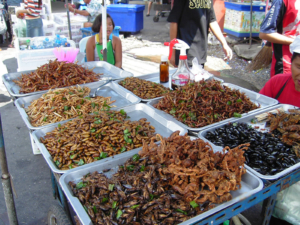 Entomophagy is the practice of eating insects. Throughout history and across geographical areas, adopting this diet has been a common and beneficial practice. Approximately 2 billion people across at least 99 countries regularly eat insects for protein, vitamins, minerals and fat content compared to meat or fish. There are about 1,900 edible insect species, from which humans eat eggs, larvae, pupae and adults. Insects of choice include bees, wasps, beetles, moths, caterpillars, crickets and grasshoppers. In recent years, researchers have explored this avenue and begun to consider the means by which entomophagy can reduce poverty.
Health Benefit
For years, insects have been viewed as a delicacy around the world. People eat boiled larvae with a nutty flavor and snack on crunchy beetles like popcorn. But bugs are also beneficial for their nutritional content: cooked grasshoppers, for example, can have up to three times the amount of protein and one-third the amount of fat compared to a hamburger. In low-income areas, insects are easily accessible from nature. People living in poverty could benefit significantly from this availability by either consuming them to prevent undernutrition or selling them at local markets to generate income.
Environmental Benefit
According to the UC Riverside Center for Invasive Species Research, insects are up to 20 times more efficient in converting food into edible tissue than cattle. Additionally, insects require far fewer resources and development to cultivate than other animals, which enables faster production (though this varies depending on the type of insect). Consuming insects offers a way to reduce crop-disrupting bugs without toxic or expensive insecticides. There is also little waste compared to cattle or other western proteins, which have to be processed and are only 40-50% edible. In contrast, people usually eat the entire insect.
Carbon emissions are lower in comparison to livestock. According to the Nutrition Bulletin from the Journal of the British Nutrition Foundation, the CO2 equivalent for beef is 2,058g/kg of mass gain, while insects have a CO2 equivalent of 68g/kg of mass gain. Many individual insect species leave an even smaller footprint.
Economic Benefit
The insect industry is diverse and can contribute to many markets. Silkworms are often used for fabrics and food, for instance, and weaver ants deter pests. The Chinese company HaoCheng Mealworm Inc. sells mealworms as flour, candy, condiments and instant noodles for human consumption. Also, this venture processes the worms into pet food for dogs, cats, birds and goldfish. Entomophagy provides economic contributions anywhere from street food businesses to commercialized companies.
Insect farming provides many employment opportunities for those living in rural areas of developing countries. Sericulture—the production and processing of silkworms—demands 11 workdays per kilogram of raw silk, a higher employment rate than any other industry. The majority of insect farming and gathering is performed on a relatively small scale through family-owned businesses, often in rural areas where employment and income are desperately needed.
Trading these insect-produced goods is essential for developing countries as well. Zimbabwe deals with countries including South Africa, Botswana, the Democratic Republic of the Congo and Zambia. Many countries in Africa, Asia and South America export insects for food. Even Europe and the United States have begun importing these products despite the relative lack of consumption in Western countries.
Thailand has a particularly prominent market for insect consumption, with imports estimated at $10/kilogram. For comparison, beef is $3.03/kilogram, and glutinous rice is $0.82/kilogram. Additionally, Thailand’s imports of these products total $1.14 million per year.
Regulations and Compliance of the Emerging Insect Market
National and international organizations play a crucial role in regulating the insect market. The Dutch Insect Farmers Association has been vital in lobbying to promote legislation and policies designed to improve quality standards, compliance and legal trading of these products.
While most of the Western paradigm does not consider insects to be a tasty snack or gourmet meal, continuing to research and develop this emerging market could prove essential in fully utilizing entomophagy to reduce poverty in rural areas.
– Sydney Bazilian
Photo: Wikipedia

