8 Facts About Education in Uganda
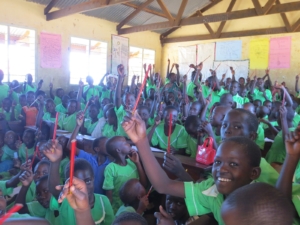
Uganda has seen significant improvements in enrollment of children in primary school over the years. As one of the youngest countries in the world with one of the fastest-growing populations, the country must work even harder to continuously improve education as a means to ensure the productivity of its increasing youth population and help reduce poverty levels. Below are eight facts about education in Uganda that show where the country stands and what more it can do to improve.
8 Facts About Education in Uganda
- Uganda’s Education System: The first of the eight facts about education in Uganda is that the country organizes its education into three different school levels, totaling seven years. These include primary school followed by secondary school, which is sectioned into two levels – the first lasting four years, followed by another two years. Finally, people attend post-secondary education, which lasts from three to five years.
- Universal Primary Education (UPE): In 1997, the Ugandan government introduced Universal Primary Education (UPE). This means that the government pays the tuition fees of all orphans in the country as well as the fees of up to four children per family. After the introduction of UPE, the number of students tripled between 1997 and 2014, from 2.63 million children to more than 7.6 million children. In 2007, the government rolled out a Universal Secondary Education (USE) program to help children continue their education.
- Uganda’s Literacy Rate: Estimates determined that the literacy rate in Uganda was 78.4 percent in 2015 with 85.3 percent of males being literate and 71.5 percent of females being literate. One can explain the lower rate of female literacy by the fact that about 52 percent of girls drop out at the primary school level either because of pregnancy or marriage. Local organizations, including GirlUp Initiative Uganda, are playing an important role in ensuring that girls get a chance to receive an education.
- School Completion Rates: While the enrollment rates of students shot up after the introduction of UPE, the number of students completing school is not as high. Only one in four students who start primary school make it to secondary school. Some factors that explain these high dropout rates include lack of school fees and money to buy important materials like uniforms, stationery and textbooks, violence in the form of caning and other corporal punishments and sexual abuse, with almost 24 percent of students experiencing sexual abuse in school.
- Disabled Children: Children with disabilities often receive neglect when it comes to education in Uganda. According to UNICEF, only 9 percent of children with disabilities enrolled in school from the pre-primary to secondary level. The exclusion of these children from formal schools could be because of the lack of accessible facilities as well as a shortage of special needs teachers. Organizations such as Cheshire Services Uganda are working at bridging the learning gap for students with disabilities.
- Teacher Absenteeism: Teacher absenteeism is high. About 60 percent of teachers in nearly half of Uganda’s public schools are not in class when they need to be. This is because of poor, inadequate facilities and overworked and demotivated teachers. Classrooms in Uganda often have up to 100 students.
- Uganda’s Education Investments: Education expenditure as a share of the national budget in Uganda is around 10 percent. This is significantly lower than the average for Sub-Saharan Africa, which is 16 percent. By increasing its investment in education, the government can improve the productivity of its citizens and help lower the poverty levels in the country.
- Improving Ugandan Education: Several organizations are working with the government to improve education in Uganda. Examples include USAID, UNICEF and the Global Partnership for Education (GPE). Organizations like these are working to enforce gender equity in schools, improve access and completion rates at the various levels of learning, increase literacy and improve early childhood development and adolescent development. The government also builds 15,000 primary school classrooms each year to accommodate any additional students.
These eight facts about education in Uganda highlight the urgent need to ensure that education in Uganda continues to improve in terms of both quality and access. The government’s and other humanitarian organizations’ efforts will help Uganda reduce poverty as well as significantly improve the lives of its citizens.
– Sophia Wanyonyi
Photo: Wikimedia Commons
