Are Anti-Narcotics Campaigns Enough for Afghanistan?
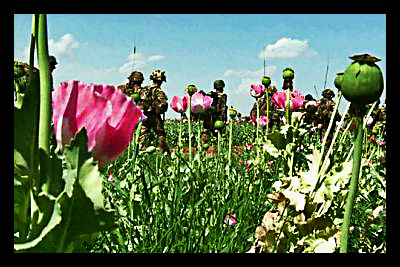
Foreign agricultural experts and the United Nations are scrambling to control the growth of a lesser-known tool of the Taliban regime – the poppy.
Production of heroin’s precursor has increased forty-fold since the War on Terror began in 2001. Afghanistan produces an estimated 90% of the world’s opium, largely due to the economic stability it affords poor farmers who cannot cover production costs by cultivating other plants.
The drug trade perpetuates political instability and encourages violence, but also supports the livelihoods of local farmers, posing a curious catch-22 for U.S. and NATO officials for whom the approval and support of the local population is of paramount importance. Since 2002, the United States has spent over $7 billion to control the opium trade, in addition to providing troops to train local counternarcotics teams and sway local officials to eliminate poppy farming from their regions. At present, some 51,000 troops remain in Afghanistan.
Unfortunately, British and American agricultural advisers who encourage alternative crops do not have economics on their side. Opium production yields ten times the profit of cotton, for example, and represents approximately 15% of Afghanistan’s Gross National Product. According to the United Nations, Afghanistan’s drug-related exports accrue U.S. $2.5 billion annually. Since 2001, the opium trade has netted over $1 trillion dollars for organized crime (namely, the insurgency).
This “dirty money” is as addictive as the drug itself; the United States’ campaign against opium has failed to curb the market’s growth. A spokesperson for the Afghanistan Counternarcotic Ministry, Qayum Samir, estimates that 154,000 hectares of poppies will be planted this spring, an increase of 18% from the previous season. A sluggish economy has increased the income gap in Afghanistan, where the ruling elite has little interest in electing an anti-opium president in the coming election. As money becomes scarcer, cooperation with drug lords becomes a necessity for poor famers, who are further marginalized by the instability that results from increased power of insurgent leaders. What results is a self-perpetuating cycle of poppy production and corruption.
Critics of the West’s counternarcotics policies claim that previous anti-drug efforts have been “too little, too late.” Rampant poverty is the root of the problem; were poppy farmers economically self-sufficient, they could avoid manipulation by insurgents and produce other crops. Though the “woulda, coulda, shoulda” mentality cannot straighten out prior strategic missteps, going forward the U.S. could appropriate funding to fighting poverty in Afghanistan rather than controlling the opium issue from the back end.
The $7 billion doled out to the region by the Untied States in the last decade is nearly triple the entire operating budget of the Food and Agricultural Organization (FAO) of the United Nations. The FAO emphasizes the necessity of sustainable food systems, public health and education as conduits for societal, economical and developmental change. Similarly, according to the Global Fund, this $7 billion would cover nearly half of the entire additional commitment needed to the reach the Millennium Development Goal to halve global poverty by 2015. Reaching this milestone would not only improve the livelihood of Afghanistan’s rural poor, but also provide them with the tools to resist coercion.
Recognizing the opium trade as a byproduct of deeper sociopolitical issues, namely widespread poverty, would allow the United States and other Western nations to develop targeted campaigns to nip Afghanistan’s poppy problem in the bud.
– Casey Ernstes
Sources: BBC, Global Research, FAO, Seattle Times, UN, World Bank, UNICEF USA
