Senior Taliban Official Backs Afghan Women’s Right to Education
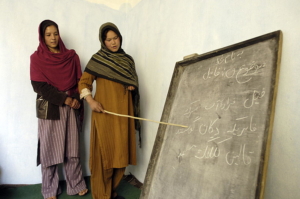 The political deputy of the Taliban’s Foreign Ministry has condemned the education bans imposed on Afghan women and girls. Since the Taliban regained control of Afghanistan in August 2021, Afghan women’s and girls’ right to education, among other human rights, has been under attack. In a speech delivered on Jan. 18, 2025, the senior official Sher Abbas Stanikzai referred to the education ban as “an injustice against” half of Afghanistan’s population and pressed for the de facto government to “open the doors of education.” This is the second time Stanikzai has publicly advocated for gender equality in education.
What Is Life Like for Women and Girls in Afghanistan?
The United Nations Assistance Mission in Afghanistan (UNAMA) released a statement on the International Day of Education, Jan. 24, 2025, noting that it has been four years since Afghanistan became “the only country in the world that explicitly bars women and girls [above the age of 12] from all levels of education.” It is not only Afghan women’s and girls’ right to education that is being violated. A series of other gender discrimination laws have been passed targeting women’s rights. The laws include the right to work, appear on TV, recite poetry or sing in public, go to the park and travel without a male relative.
The situation worsened when the Ministry of Economy shared a letter on the social media platform X on Dec. 29, 2024, threatening to shut down the activities of all nongovernmental organizations (NGOs) with women employees. Data collected by UNAMA revealed that 64% of Afghan women surveyed felt unsafe going out alone. This anxiety largely stems from “targeted harassment, threats and violence” from the Taliban and the wider community.
Men have also expressed feeling safer going out alone than with a female relative in public. Accompanying a woman draws more attention from the authorities. UNAMA notes that this has led to increased conservatism and control within families as men risk being targeted for violating the limitations placed on women and girls. Many Afghan women and girls protested the Taliban’s rise to power in 2021.
However, the Taliban responded with violence, killings and arbitrary arrests. UNAMA’s report further highlights the barriers Afghan women face when communicating with local authorities. This disconnect further removes women’s voices from public life. It increases their reliance on men in their family and community to advocate for them.
Who Are the Taliban and Stanikzai?
The Taliban is a Sunni Islamist group founded in 1994 which previously ruled Afghanistan between 1996 and 2001, implementing similar gender discrimination laws as are enforced by its regime today. Many of its members are former Afghan Mujahideen – armed Islamist groups involved in the First Afghan Civil War (1989-1992).
The first Taliban government fell after the U.S. invasion of Afghanistan in 2001, but the group regained control in 2021 after U.S troops withdrew. With the rights of women and girls deteriorating rapidly, in 2022, the deputy foreign minister condemned the closure of schools for girls. During a gathering of Taliban officials in Kabul, the country’s capital, Stanikzai urged the regime that “Women must get an education; there is no Islamic prohibition for girls’ education.”
This time around, Stanikzai directly asked the Taliban leader to reconsider the regime’s policies. He argued that there was no reason to deny education to women and girls, “just as there was no justification for it in the past and there shouldn’t be one at all.” The Guardian reported that Stanikzai is allegedly facing arrest for his comments and has fled to Dubai, though the minister has said he left for “health reasons.”
The Past
Restrictions on women’s rights have not always been the norm. The country has experienced fluctuating periods of equality and gender disparities in the past century.
For example, women’s suffrage in Afghanistan was achieved in 1919, a year before women in the U.S. were granted the right to vote. During this same period, the Queen Consort of Afghanistan, Soraya Tarzi, advocated for Afghan women’s and girls’ right to education and facilitated the opening of the country’s first school for girls in 1921. Since then, various regimes have advanced or rolled back on women’s rights.
How Has the International Community Been Responding?
Despite having been the de facto authorities for four years, the Taliban has yet to receive international recognition. The growing exclusion of women and girls from the public space has led to the U.N. labeling the Taliban’s policies as “gender apartheid.” Similarly, the International Criminal Court (ICC) issued applications for arrest warrants against two Taliban officials: the leader of the Taliban, Haibatullah Akhundzada and the Chief of Justice, Abdul Hakim Haqqani. They are charged “for the crime against humanity of persecution on gender grounds.” The ICC prosecutor, Karim Khan, also announced that other senior Taliban officials will soon face similar consequences.
With the clampdown on NGOs in the country, courses for action on the ground are becoming increasingly limited. UNAMA has been collaborating with the United Nations Entity for Women and Gender Equality (U.N. Women) and the International Organization for Migration (IOM) since August 2022 to reach out to Afghan women nationwide and gather insights about their living conditions. Their latest report revealed that 45% of women and 41% of men consulted in April 2024 believe the international community should facilitate communication between Afghan women and the Taliban. They believe centering women’s voices is crucial to advancing their rights.
– Nesreen Yousfi
Nesreen is based in Watford, Hertfordshire, UK and focuses on Good News and Politics for The Borgen Project.
Photo: Flickr
