Building Climate-Resilient Rohingya Refugee Education in Bangladesh
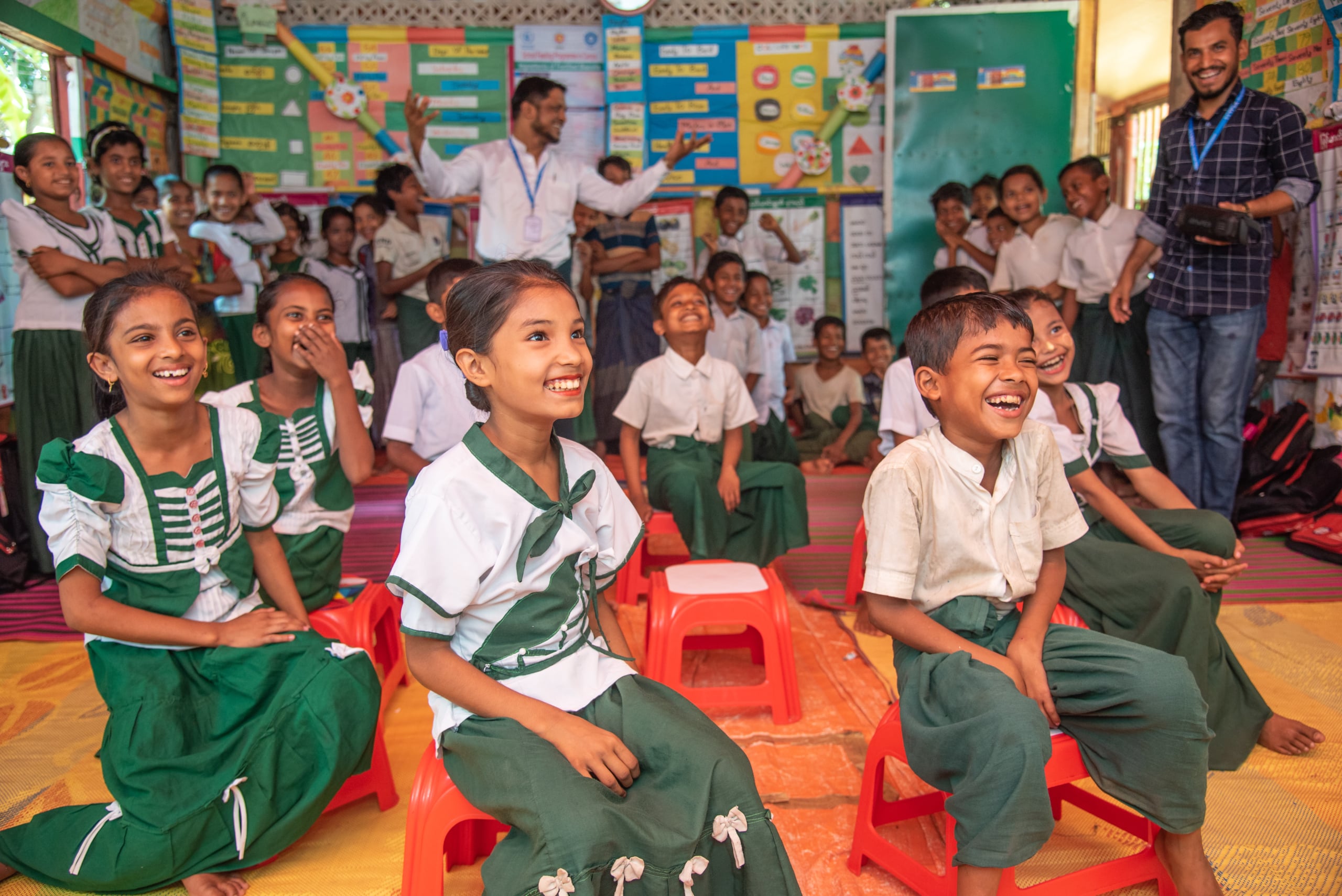
For Rohingya children growing up in Bangladesh’s Cox’s Bazar refugee settlements, education has faced an unusual challenge. The places built to provide learning have themselves been vulnerable to fires, floods, landslides and severe weather affecting the camps.
When a major fire swept through Camp 5 in January 2024, more than 5,000 Rohingya refugees, including 3,500 children, lost their homes. Around 1,500 children also lost access to education after learning facilities were destroyed. Among them was Rafik, a 13-year-old Rohingya student whose family fled violence in Myanmar. After his learning center was destroyed, he spent seven months studying in a tarpaulin classroom. UNICEF reported that the temporary space became dark and flooded during heavy rain.
The destruction exposed a wider problem. Refugee education in Cox’s Bazar has traditionally depended heavily on temporary structures, many of which were built from bamboo. In 2024, 434 UNICEF-supported learning facilities were partially or completely damaged by disasters, disrupting education for more than 30,000 children. UNICEF said the repeated repairs were costly and diverted limited resources from other education programs and humanitarian services.
These disruptions take place within a much wider problem of poverty and economic insecurity. For Rohingya refugees, the economic constraints are even more severe. A 2024 Canadian government evaluation found that 95% of Rohingya households in Cox’s Bazar were moderately to highly vulnerable in 2022 and entirely dependent on humanitarian assistance. Refugees are confined to the camps and face restrictions on formal employment, leaving many families heavily reliant on aid.
Economic and Educational Impact
For children, this economic insecurity is closely connected to education. When families have few livelihood options and humanitarian support is reduced, access to learning becomes harder to sustain. The longer children remain out of school, the fewer opportunities they have to develop the skills needed for future education, training and employment. UNICEF has previously warned that older Rohingya children and adolescents deprived of opportunities to learn or develop livelihoods face increased risks of exploitation, early marriage and other forms of harm.
UNICEF’s response has increasingly focused on making education facilities more resilient to the conditions surrounding the camps.
Innovative Solutions
In February 2025, construction was completed on the Phoenix Learning Centre, which UNICEF describes as the first fire-resistant and climate-resilient school in the Rohingya refugee settlements. The center contains 10 classrooms and provides a learning environment for more than 700 children in grades 1 through 8.
The building was designed around the hazards faced in Cox’s Bazar. Its structure uses steel framing and magnesium oxide boards designed to withstand extreme temperatures, strong winds and flooding. Rooftop solar panels supply electricity, while battery storage provides up to two days of backup power.
The center’s design also addresses concerns about safety and access for adolescent girls. Separate classrooms and toilets for girls, along with a perimeter fence, were included in the facility. UNICEF reported increased interest from adolescent girls after the center opened. A teacher at the school also reported that attendance in his classes had been consistently higher, while greater numbers of girls were interested in attending because they felt safer at the new facility.
The Phoenix center also demonstrates why infrastructure quality matters to learning itself. Rafik said the new classrooms were easier to study in because of better lighting and ventilation, allowing him to see his books and the teacher’s writing more clearly. During a 2024 heatwave, temperatures in Bangladesh exceeded 40 degrees Celsius and all schools across the country, including learning facilities in the camps, closed for several days. A better-designed learning environment therefore addresses both disaster risks and the everyday conditions affecting children’s ability to study.
Long-term Challenges
His experience reflects the wider challenge facing education in the Rohingya settlements. Children who fled violence in Myanmar have now spent years in displacement. Many were born in Bangladesh and have never attended school in their country of origin. Maintaining continuity in education therefore has implications for both their present circumstances and their future.
Rohingya refugee education also operates within a system under growing financial pressure. UNHCR and its partners provide free education services in Cox’s Bazar and Bhasan Char. Programs include basic education using the Myanmar Curriculum, formal education using the Pearson Edexcel Curriculum at Kutupalong and Nayapara registered camps and lifelong learning opportunities for adolescents and young people.
On May 31, 2025, UNICEF warned that the education of around 230,000 Rohingya refugee children was at risk because of an acute funding crisis. At the time, 83% of school-age children in the camps were enrolled in UNICEF-supported learning centers. Funding shortages forced UNICEF to suspend support for 1,179 host-community volunteer teachers working with younger learners, while some learning facilities faced temporary closure.
The funding crisis demonstrated how fragile education provision remained even when facilities were operating. A climate-resilient building still needs teachers, learning materials and funding to keep its doors open. Without those resources, improvements to physical infrastructure do not guarantee continuity of education.
International Support
By 2026, additional international support was helping sustain services. In March, Japan committed $1.4 million to UNICEF for support reaching more than 56,500 refugees, including more than 36,000 children. The funding covers education, health, nutrition and water, sanitation and hygiene services in Cox’s Bazar and Bhasan Char. UNICEF said the education component would expand the Myanmar Curriculum on Bhasan Char and support formal education and skills training for adolescents in Cox’s Bazar.
In June, UNICEF announced Australia’s commitment of $11.4 million in multiyear funding to UNICEF for 2026 through 2028. The contribution supports health, nutrition, education, water, sanitation and protection services for Rohingya children and host communities. UNICEF said the funding was especially important because shortages were placing essential services under serious strain.
In April 2026, UNICEF and the Asian University for Women announced the certification of more than 1,100 volunteer teachers working in the Rohingya refugee camps. The program was developed with the Government of Bangladesh and the Refugee Relief and Repatriation Commissioner, with the aim of strengthening teacher preparation and the quality of learning available to refugee children.
Ongoing Risks
In July 2026, heavy rainfall triggered flash floods and landslides in the camps. UNICEF reported nine deaths, including children, following incidents on July 7. UNICEF also reported that a landslide in Camp 5 the following day killed at least four girls. UNICEF said the emergencies were disrupting access to essential services and highlighted the severe risks created by monsoon conditions in the settlements.
Those events underline why resilient infrastructure has become part of the education response rather than a separate construction concern. A learning center in Cox’s Bazar needs to withstand conditions capable of damaging homes, roads and essential services around it. When schools remain usable after disasters, children have a better chance of returning to lessons without a prolonged interruption. Organizations also avoid repeatedly directing scarce funds toward reconstruction.
UNICEF estimates that every $1 invested in climate-resilient infrastructure saves an estimated $4 in post-disaster reconstruction costs.
Conclusion
The Phoenix Learning Centre therefore represents more than a replacement for a school destroyed by fire. It reflects a shift toward infrastructure designed around the long-term realities of displacement.
The challenge is particularly significant because the Rohingya crisis has lasted far longer than many emergency responses are designed for. What began as a mass displacement in 2017 has become a prolonged humanitarian situation in which children are growing up entirely within refugee settlements.
Bangladesh and its humanitarian partners are responding through several interconnected approaches. Durable learning facilities address physical vulnerability. Teacher certification strengthens education quality. International funding helps sustain services. Curriculum programs provide children with structured learning pathways.
The Phoenix Learning Centre offers a practical example of how these efforts intersect. Built after a fire destroyed the original facility, the school was designed around the risks facing the refugee settlements and was reported by UNICEF in 2025 to serve more than 700 children. UNICEF’s reporting from the center provides early evidence of practical benefits, including better classroom conditions, consistently higher attendance reported by a teacher and greater interest among adolescent girls.
As extreme weather, disasters, poverty and funding pressures continue to threaten services in Cox’s Bazar, the question is no longer simply whether children have somewhere to study. It is whether the education system supporting them is strong enough to remain available when the next emergency arrives.
– Michal Swiergocki
Michal is based in Arklow County Wicklow Ireland and focuses on Global Health and Politics for The Borgen Project.
Photo: Wikimedia Commons

