How Mangrove Honey in Indonesia Can Support Sustainable Livelihoods
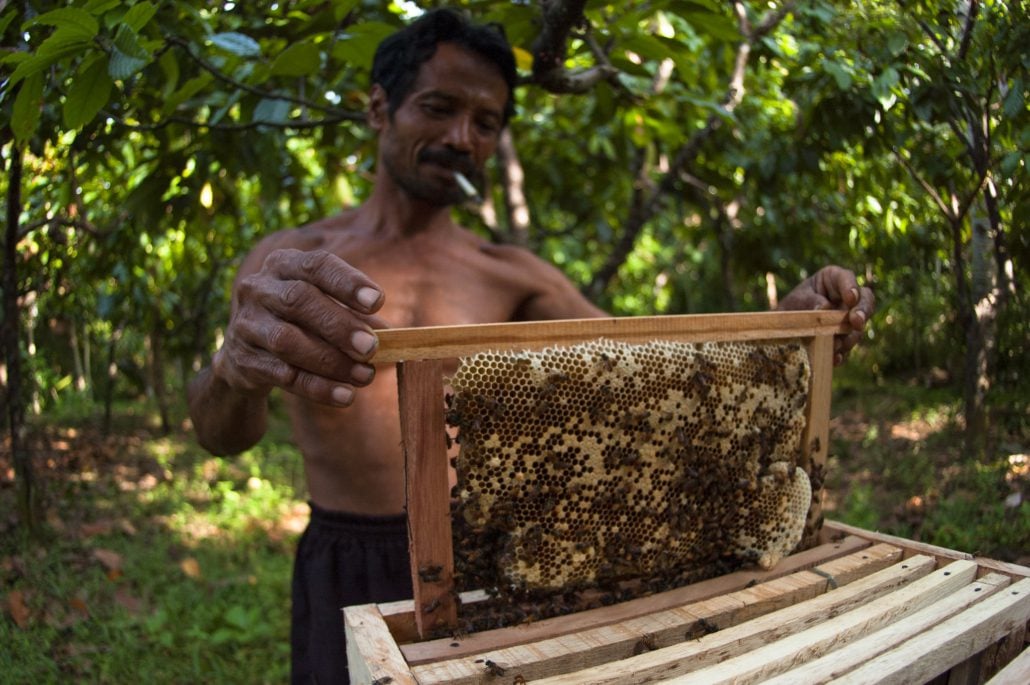
In Indonesia, mangrove honey is emerging as a promising way for coastal communities to diversify incomes while helping protect the forests they depend on. For households whose livelihoods are vulnerable to changing environmental conditions, fishing pressures and limited economic opportunities, community-based honey production offers a nature-based alternative that connects income generation with ecosystem conservation. Small-scale fisheries are a major source of livelihoods in Indonesia, with around 1.3 million households benefiting from the sector, according to Indonesia’s 2024 Blue Food Assessment. However, many of these households face high levels of poverty and vulnerability linked to declining ecosystem health and changing weather patterns. Charcoal production as an alternative source of income has also been historically relied upon, but this creates further problems surrounding conservation and sustainable, long-term income generation.
The Vulnerability of Small-Scale Fishing
Fishing is deeply connected to Indonesia’s economy and food security. As the world’s largest archipelagic state, Indonesia relies heavily on its marine resources. According to the Food and Agriculture Organization of the United Nations (FAO), small-scale fisheries account for nearly 90% of all aquatic products captured in Indonesia. This figure refers to the amount of aquatic products that small-scale fisheries catch, rather than the number of fishers, fishing vessels or people employed in the sector.
However, dependence on fishing can leave communities particularly exposed to environmental and economic changes. Research into small-scale fisheries across Indonesia has identified ecosystem degradation and climate change as significant influences on livelihoods. Changes in weather patterns, declining ecosystem health and pressure on marine resources can make fishing less predictable, highlighting the importance of diversifying coastal livelihoods.
For communities living alongside mangrove forests, fishing is also not the only livelihood connected to these ecosystems. Mangroves provide a range of resources that can support local economies, including timber and non-timber forest products. In some communities, however, the harvesting of mangrove wood for charcoal has placed significant pressure on these forests.
Indonesia’s Mangrove Economy
Indonesia is home to approximately 3.4 million hectares of mangrove ecosystems, representing more than 20% of the world’s mangrove area. These forests provide critical habitat for fisheries, store significant amounts of carbon, protect coastlines from erosion and extreme weather and provide food and income for coastal communities.
Mangroves can therefore have economic value while remaining standing. One example is honey production.
Mangrove ecosystems provide habitat and food sources for forest bees, including the species Apis dorsata, which produces forest honey collected by communities in parts of Indonesia. As a non-timber forest product, mangrove honey in Indonesia can generate economic value without requiring communities to cut down mangrove trees.
Moving Away From Mangrove Charcoal
Batu Ampar in West Kalimantan provides a useful example of the challenges facing mangrove-dependent communities. In 2017, the community received a Village Forest permit covering approximately 33,140 hectares of mangrove forest. Many residents traditionally depended on fishing, while charcoal production from mangrove wood also contributed to local livelihoods. However, the area is classified as protection forest, meaning only limited use is permitted and wood cannot legally be harvested from the protection forest. Yale’s Environmental Leadership and Training Initiative describes charcoal production in Batu Ampar as illegal and notes that it has contributed to significant mangrove deforestation and degradation.
The problem is that these two forms of economic activity can be closely connected to the health of the mangrove ecosystem. Fishing depends on healthy coastal environments, while charcoal production from mangrove wood contributes to the removal and degradation of the forest. This creates a difficult economic situation: communities depend on the forest for income, but some forms of resource extraction can damage the ecosystem that supports those livelihoods.
In 2023, Blue Forests and Yale’s Environmental Leadership and Training Initiative worked with the Batu Ampar community through a course focused on sustainable mangrove honey utilization. Rather than simply asking communities to stop using mangrove resources, the training explored how non-timber forest products such as honey could provide alternative livelihood opportunities while reducing economic dependence on charcoal production from mangroves.
Participants learned about bee habitats and life cycles, mapped honey locations, explored harvesting techniques and discussed harvest rotation and post-harvest processing. The approach connected environmental knowledge with practical skills that could help communities make greater economic use of the forest without removing its trees.
Honey as an Additional Source of Income
Mangrove honey in Indonesia does not need to replace fishing or become a community’s sole source of income. Its potential lies in diversification.
For households dependent on fishing, an additional income stream can provide greater flexibility when weather conditions, environmental pressures or seasonal changes make fishing less reliable. At the same time, honey production can create opportunities beyond harvesting itself, including processing, packaging, marketing and local entrepreneurship.
The environmental benefits are also significant. If honey becomes a viable source of income, communities have an economic reason to maintain the mangrove habitats that support bee populations. This creates a different relationship with the forest: rather than generating income through removing mangrove wood, communities can generate value from keeping a living ecosystem intact.
This does not mean honey production alone can solve poverty or prevent mangrove degradation. Market access, infrastructure, training, finance and effective environmental management are all important to whether nature-based livelihoods become economically sustainable.
Nevertheless, the Batu Ampar example demonstrates how livelihood diversification can address both economic and environmental pressures at the same time.
Building Long-Term Resilience
Mangrove honey in Indonesia illustrates how environmental protection and economic opportunity can be connected rather than treated as separate challenges.
Indonesia’s mangrove ecosystems already support coastal livelihoods through fisheries, food, coastal protection and other natural resources. The World Bank’s Mangroves for Coastal Resilience project similarly aims to improve livelihood opportunities for coastal communities alongside mangrove conservation and restoration.
For communities facing pressure on fishing and economic incentives to harvest mangrove wood for charcoal, developing sustainable non-timber products could provide another path. Honey offers one example of how a forest can generate economic value without being destroyed in the process.
For Indonesia’s coastal communities, the lesson extends beyond honey itself. Diversifying livelihoods around healthy ecosystems can help reduce dependence on vulnerable or environmentally damaging activities while creating new economic opportunities. As changing weather patterns and environmental degradation continue to affect coastal households, nature-based livelihoods such as mangrove honey could form part of broader strategies for building long-term economic resilience.
– Amber Bannon
Amber is based in High Wycombe and focuses on Good News for The Borgen Project.
Photo: Flickr
