Rouble Nagi Transforming Indian Slums into Learning Centers
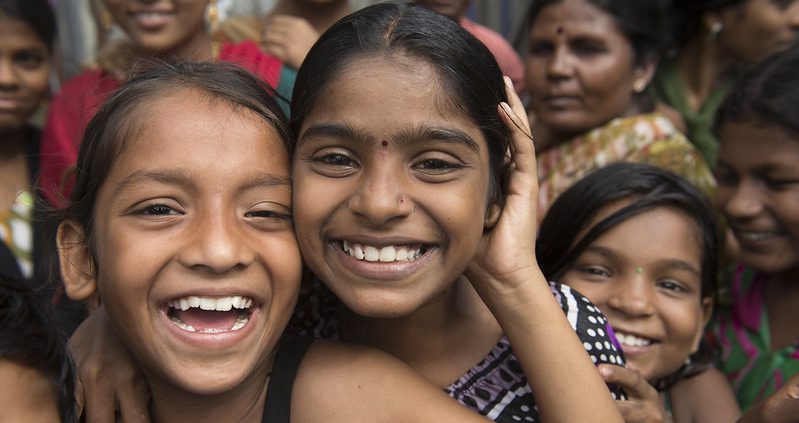 Rouble Nagi, an artist and educator who has established more than 800 learning centers across India, has received a $1 million award from the Varkey Foundation, in partnership with the United Nations Educational, Scientific and Cultural Organization (UNESCO), recognizing outstanding impact in teaching. Nagi, now 45, has spent more than two decades working in some of the country’s most underserved communities. Her organization, the Rouble Nagi Art Foundation (RNAF), is a registered nonprofit operating under the Bombay Public Trust Act, 1950, with a stated vision of ensuring that all children receive an education that helps them become caring, responsible and productive citizens.
Currently active across more than 20 cities and 163 slums and villages throughout India, the foundation has painted and repaired more than 150,000 homes to date and reached an estimated 45,000 children through its learning programs. Her approach, built on transforming Indian slums into learning centers, targets communities that India’s formal education system has consistently failed to reach, bringing structured learning directly into the streets, alleyways and open spaces of urban slums.
Turning Art Into Education
One of the ways Nagi educates in these open-air classrooms is by incorporating art into explaining certain topics through murals and class participation. Transforming Indian slums into learning centers means using the surrounding environment to the community’s advantage, and for Nagi, art is the tool that makes that possible. Teachers are encouraged to use art-based learning to simplify concepts and engage students who might otherwise have no access to formal education.
A former student of Nagi named Mayur runs his own art classes and a small printing business. On weekends, he volunteers with Nagi’s foundation, hoping to give other children from the community the same opportunities he received. His story is a testament to what access to education, however unconventional, can produce. Nagi has noted that the murals specifically engage local people by sparking their curiosity, with follow-up surveys conducted by her foundation showing a measurable increase in parents actively enrolling children in the learning centers after mural installations in their neighborhoods, a concrete indicator that community attitudes toward informal education are shifting.
Across areas like Colaba, large murals and inspirational quotes cover the walls of shanties, transforming the visual landscape of neighborhoods. The learning centers are often painted with bright colors and illustrate topics the children will study, featuring plants and animals from their respective kingdoms.
The Rouble Nagi Art Foundation
The foundation’s work extends considerably beyond education. Operating under the banner of its Misaal Mumbai project, which began after a major slum painting initiative in Dharavi in 2018 and has since expanded into a national program called Misaal India, the RNAF works across themes of women’s empowerment, youth employment, sanitation, hygiene and waste management, in addition to its core educational mission. The foundation employs local residents and art college volunteers in the creation of its murals, giving community members a sense of ownership over the work being produced in their own neighborhoods.
In 2025, the foundation established two new education centers and two additional women’s skill centers in Mumbai, while in Kashmir it upgraded existing skill centers, supplied new school benches and learning materials, and set up digital classrooms in Madrasa institutions in Pulwama and Tangdhar, giving students access to computer literacy for the first time. Plans are already in place to launch fully equipped digital classrooms in April 2026 in the remote border villages of Amrui and Jabri in Kupwara, near the Line of Control. The foundation’s government partners include the Government of Maharashtra, Thane Municipal Corporation, Vasai Virar Municipal Corporation and Pune Municipal Corporation, alongside corporate supporters including Bajaj Auto and ONGC.
Poverty, Exclusion and the Education Gap in India
In India, poverty and educational exclusion are deeply intertwined. Research consistently shows that children from the lowest income quintiles, those most concentrated in urban slums, are disproportionately likely to drop out before completing primary school or never to enroll at all. Families living in slums face compounding barriers: irregular income forces children into labor, frequent relocation due to eviction disrupts school attendance, and the direct cost of uniforms, books and transport places formal schooling beyond reach. It is precisely this population that Nagi’s model is designed to serve, by removing cost and distance as barriers entirely.
India has made significant strides in expanding access to schooling. By 2024, the country had sustained an enrollment rate of 98.1% for children in the 6 to 14 age group, signifying near-universal schooling at the primary level. Yet despite this progress, roughly 46 million children in the 6 to 17 age group remain out of school, representing approximately 17% of that population. Figures such as these make clear that initiatives like Nagi’s are not just inspiring stories but necessary interventions for communities that formal education systems have consistently failed to reach.
In 2010, India enacted the Right to Education Act, which mandates free and compulsory elementary education for all children ages 6 to 14 as a fundamental right under Article 21A of the Indian Constitution. In practice, however, significant gaps remain. According to the Deccan Herald, children of migrant workers, Scheduled Castes and Scheduled Tribes (SC & ST) communities, slum dwellers, construction workers and children with special needs are among those most likely to miss school entirely.
Looking Ahead
With the prize money, Rouble Nagi aims to expand the organization into new regions of India, including Jammu and Kashmir, where she grew up, with plans to broaden the curriculum to include computer skills. In a country where millions of children still fall through the cracks of a formal system, Nagi’s model of taking education directly to the streets offers a scalable, community-rooted alternative, and one that her $1 million prize may now help bring to an entirely new generation.
– Jamie Noone
Jamie is based in Dublin, Ireland and focuses on Good News for The Borgen Project.
Photo: Flickr
