Education or Survival? Educational Challenges in Rural Punjab
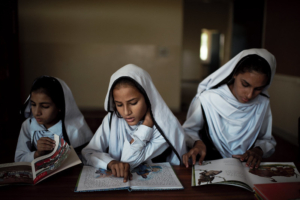 The literacy rate in Pakistan has increased significantly over time, with the national figure now exceeding 60%. Punjab leads this progress with a rate slightly above 66%. However, these statistics do not override the province’s barriers to education, particularly for working-class families. Thus, to learn more about the educational challenges in rural Punjab, The Borgen Project interviewed Laiba Waris. Waris is a 22-year-old girl whose family moved from Sialkot to Islamabad to escape societal pressure and seek better opportunities.
Despite being close to Pakistan’s industrial hubs, rural Sialkot still faces deep-rooted inequality. Most families rely on small trades, farming or daily labor to make a living. For many, educating their children, especially daughters, feels out of reach. Schools are limited, transportation is expensive and traditional gender norms remain strong.
Waris is the only one in her family still in school. Her brothers fully support her, doing what they can despite financial strain. “We do have a small business, but education expenses are a big burden,” she says.
Waris’ Story: Education Beyond Boundaries
To overcome these educational challenges in rural Punjab, Waris’ family moved to Islamabad. This marked a turning point in Waris’ life. “It’s good for my personality development and my life,” she says, explaining that university education has given her confidence and exposure that rural girls rarely experience.
Yet, the journey has not been easy. “I face difficulties in paying my fees and managing transport. My family supports me, but it’s not easy for them,” she adds. Her words reflect the quiet determination of many rural students who leave their homes in search of a better future.
The Gender Divide in Rural Punjab
Educational challenges in rural Punjab are deeply intersectional with gender. This reflects the province’s wider gender gap, where female literacy is just about 63.4% compared to 75.4% for males. In her hometown, education beyond matriculation is not very common for girls. “In our area, education is so difficult for girls after matric, very few continue,” Waris explains. “Most get married early or start working in factories.”
Waris considers herself lucky to have parents who believe in education. “They’re not conservative. They want me to study and have a good job. But there’s still a lot of social pressure. People talk, but my family appreciates me and is standing by me.” Encouragingly, she also notes progress. “In old times, there were very few girls going to school. But now, things are changing. More girls are studying and they’re more passionate than boys.”
Dreams and Determination
Waris’ ambitions stretch far beyond her village. She aspires to enter politics to represent and uplift her community. “Education is as important as water,” she says. “It gives life meaning and power. Without it, people remain trapped.”
Her words carry a powerful message for policymakers and citizens alike: scholarships, free education and transport systems are essential if rural students are to compete equally with their urban counterparts.
The Path Forward
Waris’ story, from rural Sialkot to Islamabad, mirrors the broader dilemma faced by Pakistan’s working class: whether to prioritize education or focus on survival. Her journey highlights the significance and ever-cascading educational challenges in rural Punjab.
She shares her story as both a personal triumph and a reminder that true progress depends on making education accessible to all, regardless of geography, gender or income. For now, Waris continues to study, fueled by hope that one day her success will help open doors for others in her village who still dream of learning.
– Sidra Tahir
Sidra is based in Rawalpindi, Pakistan and focuses on Technology and Politics for The Borgen Project.
Photo: Flickr
