Onesmus Okamar on Art and Education in Kenya
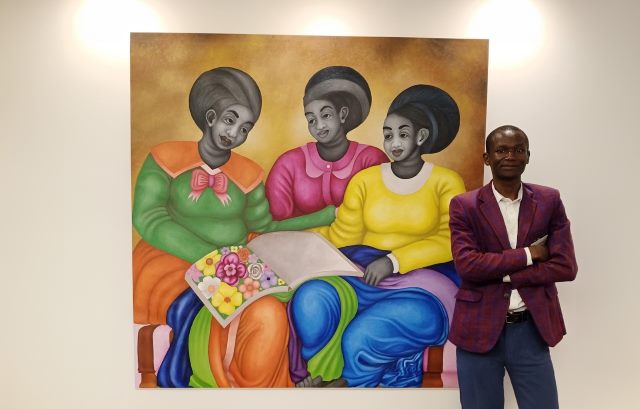 “There are many people with great talents that only lack information. If you don’t know where to take your work to sell or how to approach galleries or individual clients – how to relate to them – that becomes the biggest challenge and an obstacle for many artists and people in all fields.” The Borgen Project interviewed Onesmus Okamar, a self-taught Kenyan artist, discussing his work with the Kobo Trust, art as a tool for alleviating poverty and education in Kenya.
About Onesmus Okamar
Born in Teso-North, Busia County, Kenya, Okamar is an award-winning visual artist based in the country’s capital city, Nairobi. With no formal training, Okamar began pursuing art at age 17. Two years later, in 2014, Okamar received a commendation for the Mask Prize, an award celebrating the creativity and innovation of African youth.
While discussing art and education in Kenya, Onesmus Okamar states that one of the biggest problems that Kenyans face is an insufficiency of information and access to resources, explaining that a particular struggle for creatives is to find “a physical space where they can work and where they can invite clients to get to know their art.”
The Kobo Trust
According to Onesmus Okamar, the Kobo Trust, a charitable foundation and nonprofit founded by Kobo Safaris Ltd. in 2011, works both with artists and children from disadvantaged backgrounds, seeking to create a solution to this problem. The Kobo Trust provides a creative space for artists to use while educating, rehabilitating and sheltering children from disadvantaged backgrounds.
Okamar describes that many “kids end up in the streets because they don’t have anything to do when they finish school.” However, the Kobo Trust sponsors children through their primary, secondary and tertiary levels and “empowers them by getting them involved in businesses of their own.”
Having worked as an artist for the Kobo Trust since 2017, Okamar explains that the foundation receives 20% of any sale from its exhibitions while the remainder profits the artist directly. Through a circular scheme, the 20% returned to the Kobo Trust funds further investment in the foundation’s children, projects and partnerships.
Art as a Tool
The Kobo Trust is dedicated to sponsoring both children and artists. However, its primary goal is to use arts and culture as a tool for alleviating poverty. The foundation achieves this by using art as a tool for healing traumas while empowering, transforming and building resilience.
When asked how art can practically translate to alleviate poverty, Okamar says, “First and foremost, art must be used as a tool to find an individual’s inner voice, to help expand creativity and freedom of expression.”
The Kobo Trust encourages the freedom of expression as a means to address issues and traumas associated with poverty. It provides an outlet for children and young people to respond positively to their circumstances through art. In doing so, individuals learn that art can be used to overcome a wide variety of challenges and are edified about art as a tool to amplify wider discussions of social, economic and political concerns.
In a brief given by the United Nations Educational, Scientific and Cultural Organization (UNESCO) discussing the role of art in alleviating poverty, Dr. Kessous, UNESCO artist and ambassador for peace, described it as this: “The impact of art is underestimated today. We have a limited view of an artist as someone who produces beauty devoid of social conscience. In response, many artists decide to combine activism and art to become ‘artivists’ – offering their talents to alleviate suffering, promote peace and prevent war.”
Education in Kenya
Since 2005, Kenya’s economy has steadily grown, transcending from a low-income to a middle-income country. However, disparities in wealth distribution and access to education and health care have created a large divide between Kenya’s rich and poor. Okamar explains that “at times, even the people who may have finances around them lack the information that can help them in their careers.”
When discussing whether art is supported in the Kenyan education system, Okamar laughs, saying that “most parents in Kenya still want their children to become lawyers and doctors.” While this remains prevalent in many countries worldwide, a 2020 study showed that only 19% of Kenyans enrolled in tertiary education, indicating 23% less than the global average.
According to Onesmus Okamar, the latest curriculum does include art but doesn’t address it to be beneficial for development beyond the educational level. He states that “they [students] don’t know anything about the finance part of it. They’re not taught about marketing or using it as an income.” He likens the current system to “giving someone the equipment without giving them the manual on how to use it.”
Alleviating Poverty
Increasing education and access to resources has been proven as a way of reducing poverty. However, when combined with art, it creates a positive medium to address issues synonymous with poverty while increasing awareness and visibility of this suffering. By engaging people in the arts, disadvantaged individuals are encouraged to find their voices and positively contribute to the world around them. Art transforms mentalities, making it a powerful tool in the battle against poverty reduction.
– Zoe Winterfeldt
Photo: Courtesy of Onesmus Okamar
