The Education and Poverty Crisis in Sudan
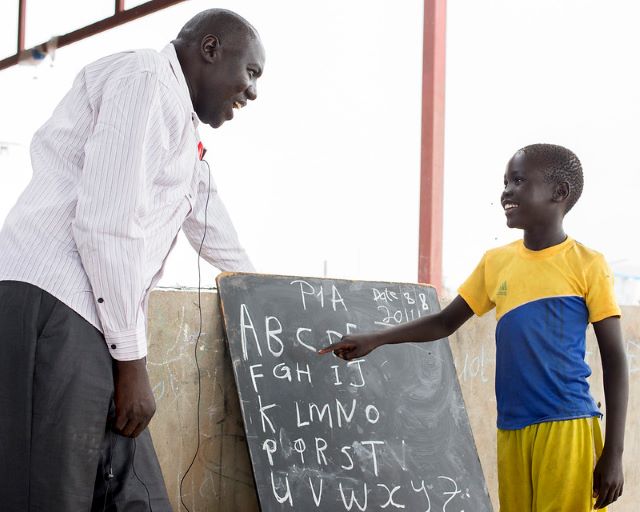 Over three million children in Sudan do not attend school. The severe gap in the education system continues the cycle of poverty in the country. Chronic underdevelopment and conflict are two of the most significant reasons children in Sudan are out of school. Girls face additional hurdles such as cultural pressures and traditional views that prevent them from receiving an education. While 76% of primary age children attend school, in secondary, the number drops drastically to 28%. The Sudanese government and organizations such as UNICEF have stepped in to resolve the education and poverty crisis in Sudan.
The Education Crisis in Sudan
In South and East Darfur, there are 7,315 employed teachers, 3,692 of which are unqualified. In essence, half of the teachers that are employed in South and East Darfur are unqualified. Furthermore, many teachers in Sudan were found to be “untrained, under supervised and unequally distributed between rural and urban areas.” Not only do schools often have teachers who are unqualified but the curriculum lacks active learning and teaching materials are either outdated or nonexistent.
The Relationship Between Education and Poverty
In their haste to escape poverty, people drop out of school in search of employment so that they can provide for themselves and their families. While a higher education often proves fruitful in finding a good-paying job, those in poverty do not have time to wait. Without an education, people living in poverty lack literacy and numeracy skills which are needed to advance in the working world. This cycle is repeated generation after generation, inextricably linking education and poverty.
Families living in this cycle of poverty often make the choice for their children, otherwise, they will not be able to provide food, water or shelter. And while some schools may be free of cost, the added costs of uniforms, books and supplies must be taken into consideration.
While poverty may have a negative effect on education, education has an increasingly positive effect on poverty. Proper education will increase one’s skill set and open the door to a world of new employment opportunities and increase the potential for higher income. With each additional year of schooling, earnings increase by about 10%. And for every dollar invested in an additional year of schooling “earnings increase by $5 in low-income countries and $2.5 in lower-middle-income countries.” UNESCO found that if all adults had two more years of schooling or completed secondary school, nearly 60 million people could escape poverty and 420 million could be lifted out of poverty, respectively.
Improving Education in the Region
The Federal Ministry of Education will implement nine strategies to improve the education and poverty crisis in Sudan. Based on these strategies, the following has been projected for the years 2018-2023: pre-school coverage will increase by 19%, basic education by 16% and secondary education by 7%.
Sudan will invest in enrollment programs and work to retain those already enrolled. The government will expand opportunities for education at every level to ensure that students do not drop out due to a lack of space. And in collaboration with global partners, the Federal Ministry of Education will work toward quality education that is accessible to all.
UNICEF’s Educational Efforts
By 2021, UNICEF intends to provide more children with the opportunity to have a quality education starting at a young age, in a learning environment that is inclusive and safe.
The organization will work with communities, parents, teachers and children to promote a socially cohesive atmosphere that even the most vulnerable of children can access. The Learning and Development Programme and the Ministries of Education will advocate for evidence-based surveys, field reports, community discussions and evaluations to mold policy reform in favor of inclusion. UNICEF and its partners will ensure the safety of schools by providing water, health and sanitation facilities. Additionally, children will be taught the proper behaviors surrounding health, nutrition and child protection. Schools will receive the support needed to ensure schools are free of violence, abuse, exploitation and neglect.
The undeniable education and poverty crisis in Sudan has prevented most people from achieving a proper education and reaching their true earning potential. While most agree that education is important, many Sudanese people find that it is a luxury outweighed by life’s bare necessities. With the five-year plan developed by the Federal Ministry of Education and the help of organizations like UNICEF, the toxic cycle between education and poverty will come to an end.
– Mary Qualls
Photo: Flickr
