Health Care on Air Delivers Healthcare in the Pacific
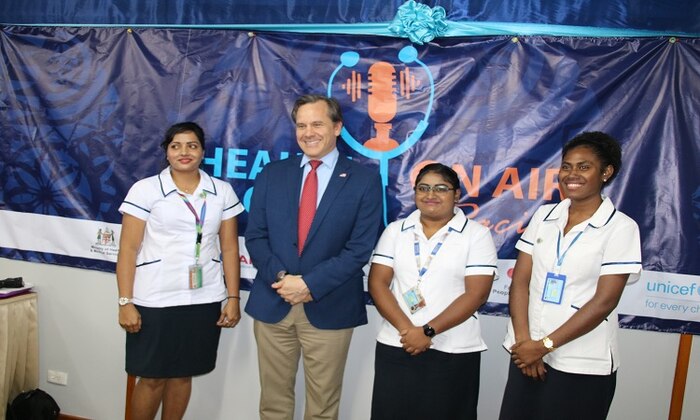
The COVID-19 crisis has cemented itself as a problem that all countries in the world must face. Complicating matters is the fact that circumstances surrounding COVID-19 are quite dynamic — changing by the day. As such, experts release new information and studies about the new coronavirus, constantly. Therefore, healthcare workers need to stay informed. For small, proximal nations in the Pacific, this is especially important. Healthcare in the Pacific faces a unique set of challenges. As Fiji’s Hon. Minister for Health and Medical Services, Dr. Ifereimi Waqainabete, says, “The global spread of COVID-19 to countries and territories indicates that ‘a risk somewhere is a risk anywhere’ and as a global village, the increasing incidence of the disease in some countries around the world is a threat to the entire Pacific.”
The Challenge
In many Pacific nations, it is challenging to ensure that all healthcare workers remain updated. “The majority of nurses and midwives in the Pacific are located in remote rural areas and outer islands, which means they often miss out on regular trainings and updates,” says UNICEF Pacific Representative, Sheldon Yett. These remote workers service more than 2 million people in the Pacific.
The Solution
To address this problem regarding healthcare in the Pacific, governments of nations therein have recently collaborated with UNICEF, the U.S., New Zealand and Japan to launch a new program called Health Care on Air. This is the first regional training program of the sort. The United States Agency for International Development (USAID) has invested $1.85 million in this program.
Health Care on Air consists of 33 half-hour-long episodes to be broadcasted on the radio and other communication channels. While standard communication platforms like TV and online training are available in the Pacific — they do not reach all workers. Importantly, radio is the only form of media that reaches every corner of the Pacific. These episodes will teach healthcare workers skills and give them the necessary knowledge to deliver effective services, during the pandemic. In addition to the training sessions, participants will be able to ask questions and share information through UNICEF’s RapidPro platform. Notably, the platform works with free SMS and other smartphone messaging apps.
Project Scope
The project is especially concerned with reducing human-to-human transmission and limiting secondary impacts of COVID-19. Secondary impacts, i.e. the additional burden and expense on healthcare systems caused by COVID-19. Efforts to limit these secondary impacts focus on preparing healthcare centers to quickly adapt to new knowledge and specializations. The focus on reducing transmission and increasing adaptability is key for Pacific Island countries. This is because they cannot handle large-scale infections in the same way that larger, developed countries do.
The first episode aired on July 10, 2020, in Fiji. The program will eventually show in 14 additional countries in the Pacific — including the Cook Islands, Samoa, Federated States of Micronesia, Palau, Tuvalu, Niue, Vanuatu, Solomon Islands, Kiribati, Nauru, Tonga, Republic of Marshall Islands and Tokelau. Notably, more than 5,000 healthcare providers will benefit from this program.
Applying Lessons Learned
In the future, the lessons learned from the Health Care on Air program will be integrated into national nursing accreditation programs as well. While the COVID-19 pandemic is a major world crisis, it is the hope that these new and innovative communication systems will continue to serve communities in the Pacific for years to come.
– Antoinette Fang
Photo: U.S. Indo-Pacific Command
