Uzbekistan is a landlocked Central Asian country, with Kazakhstan as most of its northern border, separating it from Russia. Uzbekistan was a constituent republic of the U.S.S.R. from 1924 for almost 70 years, declaring its independence from the Soviet Union in 1991.
Preschool Education in Uzbekistan
A very brief history of preschool education markers in Uzbekistan reveals the following:
- After independence from the Soviet Union in 1991, kindergarten enrollment declined from over 70% to 40%.
- In 2012, only 23% of 3 to 6-year-olds were in preschool.
- A 2016 Presidential Decree was implemented: Measures Aimed at Further Improvement of the Pre-School Education System in 2017-2021.
- In 2018, the Ministry of Preschool Education was established to centralize management. Over 11,000 children were enrolled in free one-year school preparatory groups in select regions. The program was fully implemented by 2020.
- The 2022-2026 Development Strategy of the New Uzbekistan led to 100% preschool access by 2024-2025.
GPE-World Bank Project
A five-year project (2019-2024), Promoting Early Childhood Development, funded by Global Partnership for Education and the World Bank, was established in Uzbekistan in 2019 to increase children’s access to quality early learning. The project supported two Early Learning Hubs funded by a $10 million multiplier grant plus $60 million of World Bank cofinancing. The hubs were made available to children whose access to government-financed preschools was prohibited by their inability to afford the required associated meal fees.
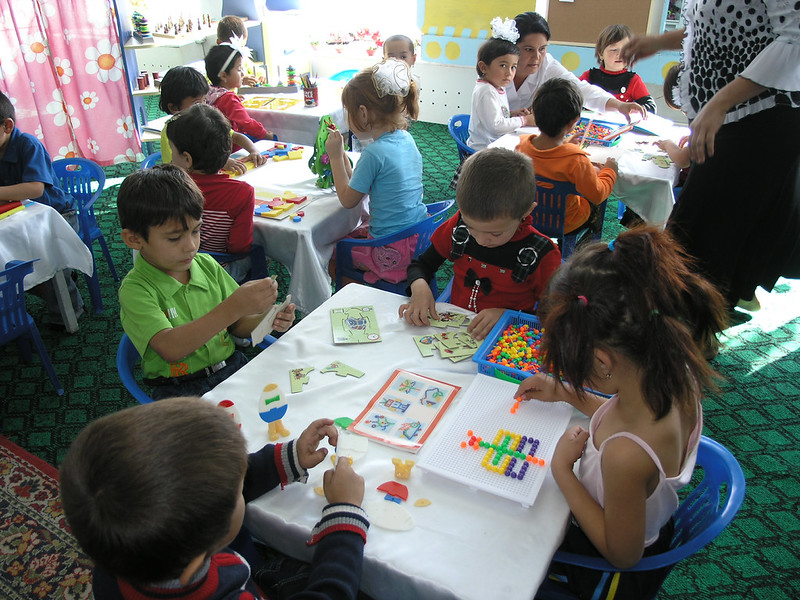
In addition to the learning hubs and other alternative preschool models implemented, as of 2022, more than 1.9 million 3- to 7-year-old children had been enrolled in 8,875 public preschools, and 60 early learning play groups were established in the hubs of two regions, which benefited more than 2,000 families. Preschool enrollment more than doubled from 30% in 2018 to 69% in 2022.
2030 Strategy Goals
In September 2023, Uzbekistan adopted the “Uzbekistan – 2030” strategy, with five priorities and 100 goals. A draft update has been developed for 2026-2030 and published for nationwide public discussion. Education goals for achievement by 2030 include the improvement of preschool education and universal coverage of children. But scope of the strategy is much broader: ensuring that 50% of secondary school graduates receive higher education and can obtain employment with fair wages. It is also intended that 10 institutions of higher education will be included in the global top-1000 rankings. Also to be implemented is an enterprise-university-research organization cluster system to accelerate the integration of research into economic practice.
2026: A Transition for Primary Education
In September 2025, Uzbekistan’s Deputy Minister of Preschool and School Education announced that the country would expand its current eleven-year system of education to twelve years by adding one year of school preparation prior to the first four grades of primary education. This would be followed by five years of general secondary education, through grade nine, and then two years of secondary education (grades 10-11). The final two years of secondary education is offered by general schools, academic lyceums, military schools and technical colleges, and is expected to facilitate Uzbek students’ entrance to foreign universities. With the addition of this year, pre-primary education became an official part of the country’s education system.
A Global Model
Global Education Monitoring 2026 (GEM) describes Uzbekistan as a global model in early childhood education, with enrollment jumping from 28% in 2017 to 78% today. This made Uzbekistan the only country worldwide to triple preschool enrollment in just seven years. UNESCO experts referred to this as “one of the fastest-growing and most dynamic globally in early childhood education.” Factors driving this success include public-private partnerships, family-based kindergartens and mobile preschool groups, all of which have increased access, especially in underserved areas. Minister of Preschool and School Education E’zoza Karimova attributed success to the role of political commitment in developing systemic reform and adopting models that have the flexibility to ability to scale nationwide.
– Nergis Sefer
Photo: Flickr
