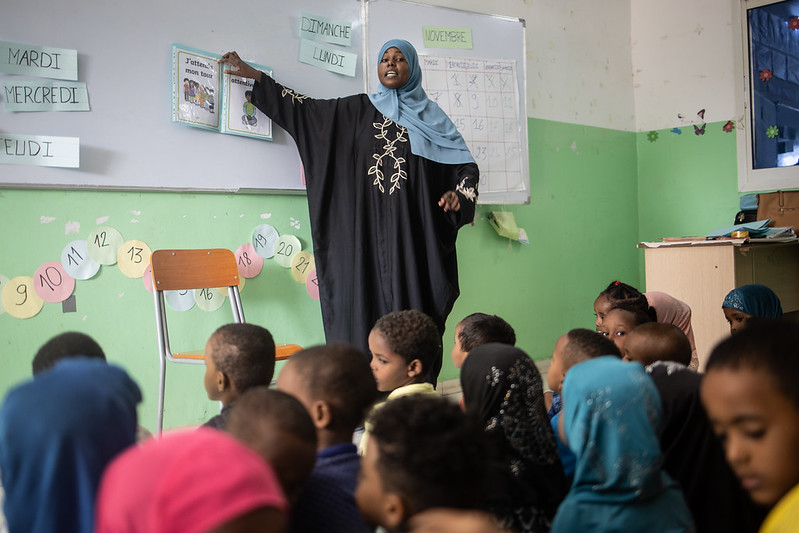
The middle-income Republic of Djibouti, one of the smallest countries in Africa, is located on the Gulf of Aden and the Red Sea, between Eritrea and Somalia. It shares an extensive (212-mile) border with Ethiopia, and its ports provide Ethiopia economic access to rest of the world, handling 95% of Ethiopia’s trade. Its population of just under one million is 79% urban. Somalis comprise 60% of the population, and Afar 35%, with a history of tension between the two ethnic groups.
Education System
Education in Djibouti is based on the French system. It is free and compulsory from ages 6-15, although attendance is not enforced. After five years of primary school, students attend either a general academic or vocational lower secondary school for four years. Vocational upper secondary school is a two-year program, while technical and general upper secondary schools are three-year programs. The University of Djibouti and the Center for Personnel Training and National Education offer post-secondary programs.
More than a decade ago (2014), Djibouti launched Vision 2035, a comprehensive strategic plan targeting economic leadership, well-being of Djiboutians, and sustainable development. Investing in education and enhancing educational outcomes was a critical element of one of the plan’s five pillars, “consolidation of human capital.” Challenges to education in Djibouti include the fact that many children do not attend, or drop out of, school; there are issues of access, education quality, availability of materials, sufficient facilities and disparities related to socioeconomic position, geographic location and gender. These challenges affect different groups disproportionately, specifically, girls, disabled children, street children, migrants and refugees. One consideration made for refugee children has been the translation of the national curriculum into English and Arabic, as well as training teachers in two of the local languages. https://brokenchalk.org/author/p-thindwa/
Increasing the Opportunity for Education
Almost 40% of the 35,000 refugees and asylum seekers in Djibouti— primarily from Somalia, Ethiopia and Yemen—are school-age children. In December 2017, the Intergovernmental Authority on Development (IGAD)—of which Djibouti is a member—set up a meeting in Djibouti that developed a Plan of Action on Refugee Education in the IGAD Member States. The plan was for safe education, fair for everyone, in the countries where they live. This would include making schools for refugees part of the country’s school system.
Since 2017, refugee student schooling in Djibouti has followed the guidelines of the national curriculum, which represented a “significant change” from the previous multiple curricula. Since then, there has been a steady increase in the number of students. Maria Abdi Mohammed, age 13, is a Somalian refugee attending Kulmiye College in the refugee village of Ali Addeh. Kulmiye College is one of 15 refugee schools in Djibouti. Says Maria, “I love going to school and working towards my future. I am one of the best students in my class.”
GPE (Global Partnership for Education), the World Bank and other partners are supporting a $30.35 million “Expanding Opportunities for Learning Project” (PRODA) in Djibouti. The mission of PRODA is to increase equitable access to basic education, improve teaching practices and strengthen the management capacity of Djibouti’s Ministry of National Education and Vocational Training. At the same time, PRODA will provide Djibouti support for the inclusion of refugee children in the country’s education system. This is consistent with the country’s law to give “refugees the rights to a life equivalent to that of citizens.”
By the beginning of 2024, 14,000 previously out-of-school refugee and Djiboutian children were enrolled, with expectations of an additional 10,000 children to follow.
In December 2024, the World Bank reported that over 23,000 out-of-school children had been enrolled, with a goal of an additional 12,000. The government was committed to building 43 new preschool classrooms for 1,075 children. Refugee inclusion is a focus, to provide equal educational opportunities for all children.
In May 2025, The World Bank approved $11.35 million in additional financing for PRODA, bringing total project financing to $41.7 million. The initiative was particularly to assist vulnerable groups, including refugees and special needs children, girls and rural communities. Goals addressed expanded access and retention in primary and lower secondary schools, developing quality preschool education and strengthening teaching and learning systems, as well as improving the ministry’s management and data capacities.
Progress in Sustainable Development
While there are plans and strategies, funding and support, and changes and improvements happening, it is not now possible to assess the extent and impact of changes to Djibouti’s policies and practices, either in general or with regard to education.
One useful source of information on development change is a country’s progress toward the U.N.’s Sustainable Development Goals. Overall, Djibouti ranks 149 out of 167 countries on its overall progress regarding the SDG targets, not having achieved any of the 17 SDGs. For SDG 4, Quality Education—ensuring inclusive and equitable quality education and promoting lifelong learning opportunities for all—information for Djibouti is unavailable.
In addition to implementing educational improvements, therefore, Djibouti will need to collect, analyze and disseminate related educational outcome information, so that it can assess its success and determine what else it needs to do.
– Mary Kate Luft
Photo: Flickr
