Cocoa Workers in Ghana: Certification and Co-Operatives
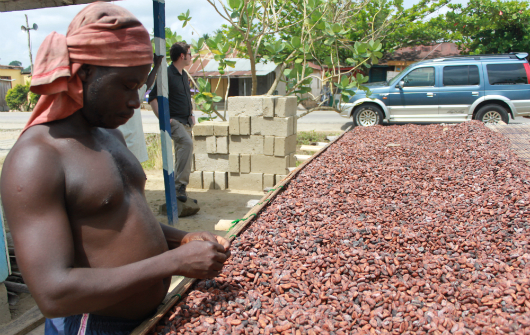
In Ghana, the cocoa bean sector is the second-largest economic sector behind gold. Accordingly, the welfare of the workers takes on heightened importance because of their magnitude and the importance they play in the Ghanaian economy.
In 2010, cocoa accounted for 8.2% of Ghana’s GDP and 30% of total export earnings. Cocoa production in Ghana is based on smallholder farms, which grow 90% of the cocoa. In total, in a country of roughly 26 million, around 700,000 households grow cocoa, and the livelihood of about 6 million people depends on the cocoa sector.
Beginning in 1947, Ghana’s government stepped forward to tightly control the cocoa trade. In the 1990s, this control slightly loosened at the behest of the World Bank and International Monetary Fund in order to provide loans for “structural adjustments.” This loosening led to the liberalization of internal marketing and privatization of the input market. Ultimately, relative to other cocoa producers in the world, Ghana still has a controlled marketing system.
In Ghana, there are many steps in the supply chain to get the cocoa beans from the farm to the manufacturer. According to the Cocoa Initiative, there are 7 to 10 steps, but in essence, the farmers sell their cocoa to a private buying company, which sells it to the Ghanaian government cocoa marketing board, which sells it to international buyers.
These extra steps in the supply chain move the producer farther from the consumer, siphoning the profits that the farmer would make if he or she sold directly to international buyers, to other actors in the supply chain. Looking beyond Ghana, Oxfam America estimates that cocoa farmers around the world make about three percent of the price of a chocolate bar.
Some global chocolate companies such as Nestle, Hershey and Mars have recognized the unsustainable aspects of cocoa farming in places such as Ghana. These companies, along with nine others, have joined the World Cocoa Foundation’s “CocoaAction” sustainability strategy. The strategy, comprised of educational opportunities and teaching farmers productivity-increasing farming methods, will affect 100,000 farmers in Ghana by 2020.
Ghana’s cocoa farmers have not sat idly by, either. To combat their disempowerment at the bottom of the supply chain, some farmers have turned to certification. Certification is a model in which farmers are awarded a premium, in addition to the price they receive for their cocoa when they work with certified chocolate companies.
Other Ghana cocoa farmers have created co-operatives, most notable of which is Kuapa Kokoo, meaning “good cocoa farmer.” Founded in 1993 and Fair Trade certified in 1995, the co-operative is a democratically run organization that brings its farmers into direct relationships with Fair Trade buyers. The Kuapa Kokoo co-operative made a historic move by forming its own chocolate marketing company, Divine, in 1999. This addition to the organization removes another actor from the supply chain, further facilitating the flow of money from the international buyers to the farmers who grew the cocoa.
By 2013, the co-operative had grown to hold over 87,000 members, of which 32% are women. Beyond dealing with the private sector, the co-operative has enough clout on village levels to leverage much support from the government, such as scholarships, credit and development resources.
These supports will prove crucial in improving the bargaining position of cocoa farmers and also allow them to educate their children. These benefits are the goal of arrangements such as certification and co-operatives, which have proved themselves to be effective in empowering the disempowered in Ghana.
– Connor Bohannan
Sources: Cocoa Initiative, Divine Chocolate, Fairtrade, FAO, Ghana Cocoa Board, NBC, Papapaa, WIEGO
Photo: Flickr
